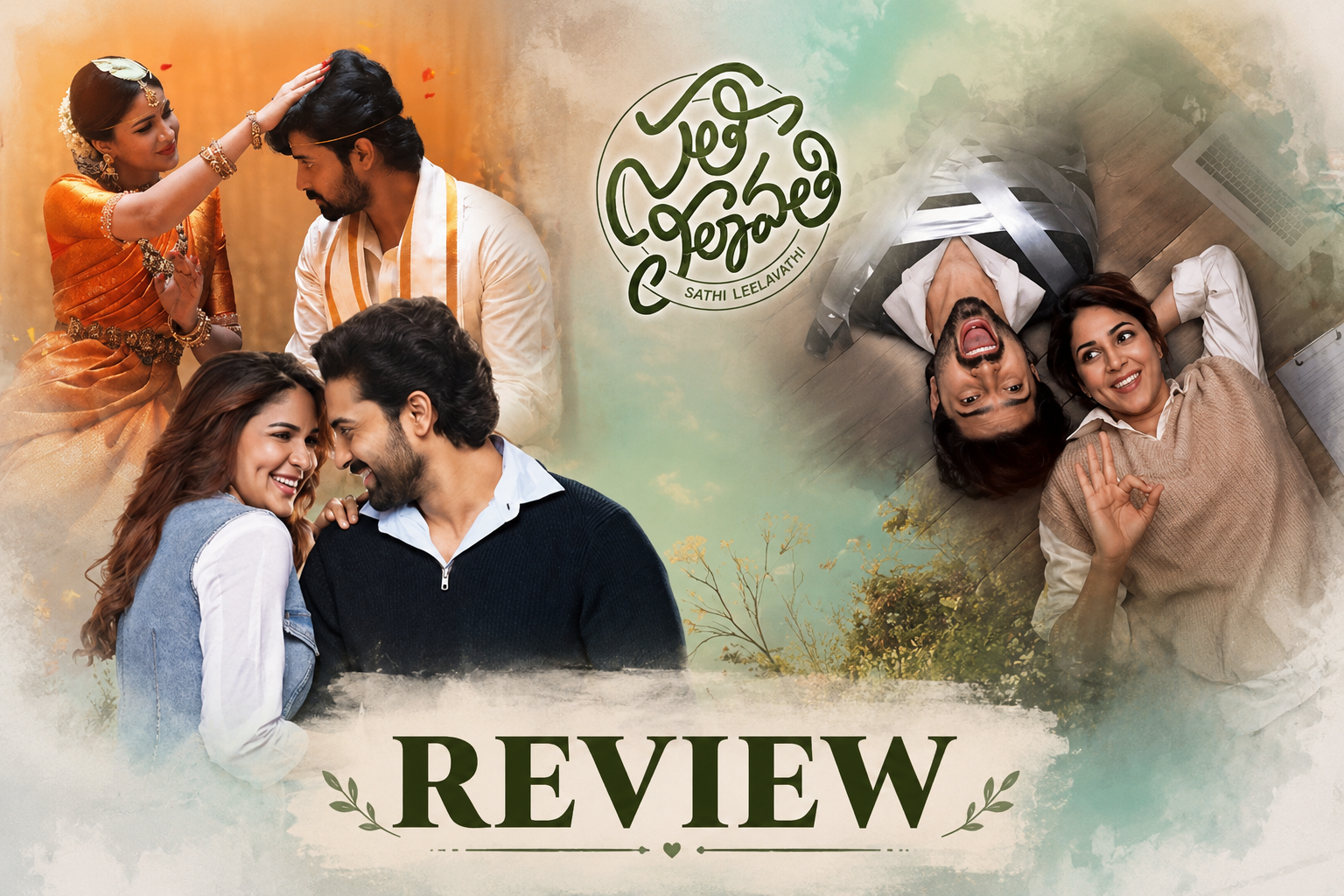
Sathi Leelavathi is a Telugu relationship comedy releasing worldwide on May 8, 2026, directed by Tatineni Satya and starring Lavanya Tripathi Konidela and Dev Mohan as a married couple whose relationship fractures and then spirals into chaotic, comedic confrontation. Presented by Anandi Art Creations and produced by Nagaa Mohan under the Durga Devi Pictures banner, the film carries a clean U certificate, making it one of the few genuinely family-friendly releases on a day otherwise dominated by darker material. What sets it apart before a single frame is seen is that Lavanya Tripathi completed her portions while pregnant, with the full support of the team working around her schedule. That commitment shows in her performance, which is the single best thing about the film.
Watch the official trailer here: Sathi Leelavathi Official Trailer – YouTube
| Detail | Info |
|---|---|
| Movie Name | Sathi Leelavathi |
| Language | Telugu |
| Theatrical Release | May 8, 2026 |
| OTT Release | Not announced yet |
| Platform | Theatre |
| Cast | Lavanya Tripathi, Dev Mohan, Naresh V.K., Sapthagiri, VTV Ganesh, Motta Rajendran, Tagubothu Ramesh, Jaffer Sadiq, Joshi, Madonna Sebastian |
| Director | Tatineni Satya (Bheemili Kabaddi Jattu, SMS) |
| Music | Mickey J. Meyer |
| Cinematography | Binendra Menon |
| Editing | Sathish Surya |
| Writer | Abhinaya Srinivas |
| Production | Durga Devi Pictures |
| Presenter | Anandi Art Creations |
| Producer | Nagaa Mohan |
| Certification | U (Universal) |
| Our Rating | 6 / 10 |
Is Sathi Leelavathi Worth Watching?
Yes, for families and for anyone who enjoys a relationship comedy built around a woman who refuses to quietly accept an unfair situation. Lavanya Tripathi’s performance is the film’s backbone, and she carries scenes that would otherwise feel routine through sheer energy and conviction. The comedy has enough genuine moments to keep the runtime from feeling long, the clean U certificate makes it ideal for family viewing, and the supporting cast, particularly Naresh V.K. and Sapthagiri, add reliable laughs in every scene they are in. It is not a film that breaks new ground, but it delivers comfortably on its promise.
What Is Sathi Leelavathi About?
Leelavathi, played by Lavanya Tripathi, is a film director by profession. Her married life with Ram Sethu initially appears settled and happy. She has built a life with him and invested herself fully in the relationship. Then she discovers that Ram Sethu has been involved with another woman and, confronted with the situation, he does not ask for forgiveness. He asks for a divorce.
Leelavathi refuses to accept it. What follows is not a melodrama about a woman who crumbles. It is a comedy about a woman who decides that if the marriage is going to fall apart, it will fall apart on her terms, in a manner that is chaotic, loud, and ultimately illuminating about what both of them wanted and failed to communicate. The kidnapping of Ram Sethu, played by Dev Mohan, becomes the film’s central comedic engine, and the confrontational sequences between the two of them drive both the laughs and the eventual emotional resolution.
The film carries a clear point of view: no woman should have to accept being treated as disposable, and the comedy itself is the mechanism through which Leelavathi refuses to accept that treatment. That the film does this without being preachy, as Lavanya Tripathi herself noted in interviews, is one of its more significant achievements.
What Works
Lavanya Tripathi’s performance is career-best work. She has always been likeable on screen, but Sathi Leelavathi asks her to be aggressive, chaotic, emotionally raw, and funny simultaneously. She handles all four registers within the same scene without any of them cancelling the others out. The fact that she completed this physically demanding role while pregnant, adapting the action sequences where necessary, speaks to a level of professional commitment that the performance itself reflects. She commands every scene she is in.
Dev Mohan as Ram Sethu is the right kind of difficult to watch. He does not play Ram Sethu as a cartoon villain. He plays him as a man who is thoughtless rather than malicious, which is actually harder to forgive and therefore more dramatically interesting. His performance in the confrontation sequences, particularly when Leelavathi forces him to account for what he has done, is better than his screen time in Telugu cinema to this point would have suggested.
The female lead’s agency is genuine, not decorative. The film is structured so that Leelavathi drives every major story development. She does not wait for anyone to rescue her or validate her. She decides what is going to happen and she makes it happen. For a Telugu commercial entertainer targeting family audiences, that is a genuinely meaningful creative choice.
Naresh V.K. and Sapthagiri in supporting roles. Both actors have delivered reliable comedic support across many films, and both are well-used here. Their scenes with Lavanya Tripathi generate the film’s most consistently funny moments, and their comic timing is in good enough shape to make even weaker jokes land through delivery alone.
The U certification opens the audience right up. Releasing with a clean universal certificate on a day when the competition includes A-rated and UA16+ content is a smart positioning decision. Family groups who might otherwise skip the May 8 theatrical releases have a genuine option in Sathi Leelavathi, and the promotional material has targeted exactly that audience effectively.
Mickey J. Meyer’s music fits the tone. His score understands that this is a comedy with a sincere emotional undercurrent, and it matches the film’s tonal shifts between chaos and feeling without jarring the audience out of either. The songs generated decent reception in the promotional period and hold up in context.
Ram Charan releasing the trailer. A major star launching the trailer of a small-to-mid-budget family comedy significantly expanded its reach beyond what the film’s own profile would have achieved. Lavanya Tripathi acknowledged this directly at the trailer launch, and the bump in awareness was visible in the promotional traction that followed.
What Does Not Work
The middle section loses some momentum. After an energetic setup and a first half that establishes the comedy register clearly, there are portions in the second half where the film settles into repetitive confrontation beats before finding its way to the resolution. The pacing does not derail the film, but it creates a dip in energy that a tighter edit could have addressed.
The male lead’s character arc is not as fully written as the female lead’s. Ram Sethu’s journey from thoughtless husband to someone who genuinely understands what he did wrong is compressed into the final act in a way that feels slightly rushed. The writing invests most of its attention in Leelavathi, which is the right priority, but Ram Sethu’s resolution needs a little more scaffolding to feel fully earned.
Some of the comedy ensemble scenes overstay their welcome. The supporting cast is strong individually but occasionally the group scenes are stretched beyond the point where they are generating fresh laughs. Knowing when to cut away from a comedic situation is an editorial skill, and a few scenes in the first half needed a slightly quicker exit.
Comparisons to Kamal Haasan’s classic will be unavoidable. The original Tamil Sathi Leelavathi from 1995 is a beloved comedic classic. This film shares only the title and the general theme of a troubled marriage. They are entirely different stories. Lavanya Tripathi was correct to pre-empt the comparison in interviews. But for audiences who love the original, the expectation management will matter.
Performances
Lavanya Tripathi (Wikipedia) has been a likeable presence in Telugu cinema since Bhale Bhale Magadivoi (2015), but nothing in her career to this point has asked her to do what Sathi Leelavathi asks her to do: be the aggressive, driving comedic force of an entire film while also landing the emotional beats that give the comedy its weight. She succeeds completely. This is the performance that reframes her as a full leading lady rather than a supporting romantic presence.
Dev Mohan (Wikipedia) is a Malayalam actor known for Sufiyum Sujatayum and Varshangalkku Shesham. This is his second significant Telugu outing, and he handles both the dubbing and the character dynamics with more ease than his relative unfamiliarity with Telugu comedy convention might have allowed. He dubbed the role himself, which is a commitment that pays off in the naturalness of his line delivery.
Naresh V.K. (Wikipedia) and Sapthagiri (Wikipedia) are the film’s most reliably funny presences in the supporting tier. VTV Ganesh, Motta Rajendran, Tagubothu Ramesh, and Joshi all contribute to the comic ensemble without any single supporting performance overwhelming the lead dynamic.
Madonna Sebastian plays a crucial role that connects to the central dramatic conflict. Her character is not a caricature, which is important for the film’s point of view to work.
Direction, Writing and Technical Elements
Tatineni Satya directed Bheemili Kabaddi Jattu (2012) and SMS (Shiva Manasulo Shruti, 2012), both of which showed an ability to handle relationship-driven comedies with genuine warmth. Sathi Leelavathi brings him back to that genre after a gap, and the familiarity with the territory is visible in how comfortably the film inhabits its tone.
His clearest strength here is in directing Lavanya Tripathi. He finds her comic registers and supports them with staging and reaction shots that amplify what she is doing rather than competing with it. Where he is less assured is in managing the ensemble comedy sequences, which occasionally go on longer than they should.
The screenplay by Abhinaya Srinivas gives the film a clear point of view and a central character with consistent motivation throughout. The comedy is built on recognisable relationship logic rather than on random situational absurdity, which gives it more replay value than the average Telugu comedy.
Binendra Menon’s cinematography is clean and bright, matching the film’s family-friendly tone. Sathish Surya’s editing could have been tighter in the second half. Mickey J. Meyer’s music is a warm, unobtrusive companion to the story.
Frequently Asked Questions
Is Sathi Leelavathi worth watching in theatres?
Yes, particularly for families. It is one of the few May 8 releases with a clean U certificate and a tone that works for all ages.
Is Sathi Leelavathi a remake of Kamal Haasan’s film?
No. The two films share a title and the general premise of a troubled marriage, but they are entirely different stories with different characters and a different approach. The 2026 Sathi Leelavathi is an original screenplay.
Who directed Sathi Leelavathi 2026?
Tatineni Satya directed the film. He previously directed Bheemili Kabaddi Jattu and SMS (Shiva Manasulo Shruti).
Did Lavanya Tripathi shoot this film while pregnant?
Yes. She confirmed in multiple interviews that she discovered she was pregnant during the shoot and completed her portions with full team support. Some action sequences were adapted to accommodate this.
Who is Dev Mohan?
Dev Mohan is a Malayalam actor who became widely known for Sufiyum Sujatayum (2020) and Varshangalkku Shesham (2024). Sathi Leelavathi is one of his notable Telugu outings. He dubbed for his own role in the film.
What is Leelavathi’s profession in the film?
Lavanya Tripathi plays a film director in the story.
What is the certification of Sathi Leelavathi?
The film has been awarded a clean U (Universal) certificate, making it appropriate for all audiences.
When will Sathi Leelavathi release on OTT?
No OTT platform or date has been announced as of May 8, 2026.
Final Verdict
CinemaCelebs Rating: 6 / 10
Sathi Leelavathi is a warm, well-intentioned family comedy that earns its best moments through a genuinely committed lead performance. Lavanya Tripathi does career-best work, Dev Mohan handles the difficult task of playing a man the audience needs to dislike and eventually understand, and Tatineni Satya keeps the film in its lane without overreaching. The second half loses some energy and the male lead’s arc needed more development, but neither flaw seriously damages the overall experience. This is the kind of film that finds its audience through word-of-mouth on weekends rather than through opening day numbers, and the word-of-mouth it deserves is positive.
Watch it if: You want a family-friendly Telugu comedy built around a strong female lead who refuses to accept being treated as disposable.
Skip it if: You are expecting the intensity of the original Kamal Haasan classic, or you need a second half that matches the energy of the first.