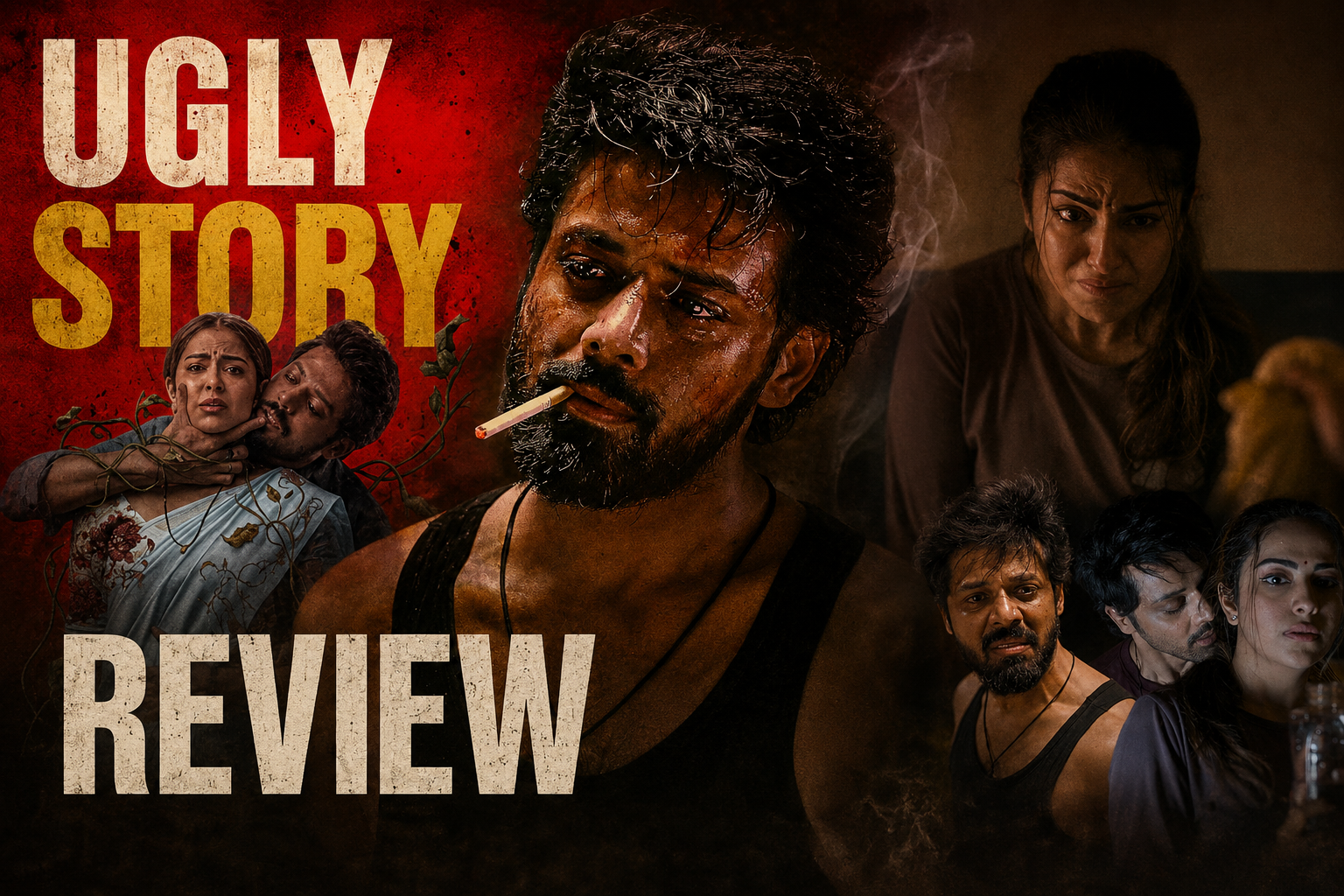
Ugly Story is a Telugu psychological romantic thriller releasing in theatres on May 22, 2026, written and directed by Pranava Swaroop, starring Nandu and Avika Gor in the lead roles. This is not a film about love as Telugu cinema usually frames it. It is about what obsessive attachment does to two people, what it looks like from the inside, and how quietly a relationship can tip from something that resembles love into something that controls and suffocates. Certified A, running 2 hours and 3 minutes, Ugly Story is a bold, uncomfortable, and genuinely different kind of Telugu romantic thriller.
Watch the official trailer here: Ugly Story Official Trailer – YouTube
| Detail | Info |
|---|---|
| Movie Name | Ugly Story |
| Language | Telugu |
| Theatrical Release | May 22, 2026 |
| OTT Release | Not announced yet |
| Platform | Theatre |
| Cast | Nandu (Shree Nandu / Nandu Vijay Krishna), Avika Gor, Ravi Teja Mahadasyam, Pragya Nayan, Sivaji Raja |
| Director | Pranava Swaroop |
| Writer | Pranava Swaroop |
| Music | Shravan Bharadwaj |
| Production | Riya Jiya Productions (also listed as Lucky Media and Riyaziya Productions) |
| Producers | Bekkem Venugopal, Subhashini, Konda Laxman |
| Genre | Psychological Romantic Thriller |
| Runtime | 2 hours 3 minutes |
| Certification | A (Adults Only) |
| Our Rating | 6.5 / 10 |
Is Ugly Story Worth Watching?
Yes, for a specific kind of Telugu cinema audience. If you want a dark, psychologically intense relationship thriller that does not flinch from making you uncomfortable, this is exactly that. Avika Gor gives a performance that carries the film’s emotional weight almost entirely. Nandu matches her in the more difficult stretches of the story. Pranava Swaroop’s direction respects the audience’s intelligence and does not soften the material for easier palatability. For viewers who want Telugu cinema to go to darker emotional spaces, Ugly Story goes there.
Not recommended for family viewing or for audiences expecting a conventional Telugu romantic experience. The A certification is earned.
What Is Ugly Story About?
Neha, played by Avika Gor, is a woman whose life is peaceful before Karthik arrives in it. Karthik, played by Nandu, is intense, attentive, and initially reads as someone deeply invested in the person he loves. That intensity is the film’s central dramatic engine.
What Ugly Story does carefully and deliberately is show how Karthik’s presence gradually shifts in register. The attention becomes surveillance. The care becomes control. The love, or what he calls love, becomes a form of possession that strips Neha of her space, her agency, and eventually her sense of safety. The film traces that shift with enough patience that the audience feels the temperature change rather than being told about it.
The psychological consequence of living inside that kind of relationship, what it does to Neha’s self-perception and decision-making, forms the film’s second half. And unlike most Telugu romantic thrillers where the resolution involves external rescue, Ugly Story is more interested in Neha’s internal journey than in a conventional climax.
Karthik is not written as a cartoonish villain. He is written as a man who genuinely believes what he feels is love, which is precisely what makes him dangerous and what makes the film interesting. The line between intense romantic investment and toxic obsession is the territory Ugly Story plants itself in and refuses to leave.
What Works
Avika Gor’s performance is career-defining work. She has always had the instinct for emotional authenticity on screen, but Ugly Story gives her material that demands more than instinct. Neha’s arc from a woman in love to a woman trapped in something she does not fully understand yet, to a woman who has to reckon with what has happened to her, requires three distinct emotional registers in one film. Avika navigates all three without a seam showing. Her own statement that the role would make audiences uneasy was not promotional overreach. It is exactly what happens.
Nandu handles the most difficult character brief in the film. Playing Karthik without making him a traditional villain, keeping the character’s genuine affection for Neha visible even as his behaviour becomes increasingly controlling, is not a simple acting task. Nandu succeeds in keeping Karthik human throughout, which is far more disturbing than a conventional antagonist portrayal would have been.
Pranava Swaroop’s direction trusts the audience. There are no musical cues telling you when to be scared. There is no moment where a character explains to another character, and therefore the audience, what is happening in the relationship. The film shows. The discomfort is earned through accumulation, the same way the real dynamics it is depicting work, and that restraint is the strongest creative decision in the film.
The A certification is earned, not exploitative. The film uses its adult certification to occupy emotional and psychological territory that Telugu cinema has been reluctant to enter. The darkness here is relational and psychological rather than gratuitously violent. It is the correct certificate for this material, and the film uses the freedom it provides responsibly.
Nandu’s creative pre-release promotions showed genuine investment. He appeared in a Blinkit delivery boy costume promoting the film in public, then dressed as a vegetable seller in local markets. Both went viral. That level of creative, engaged promotion from a lead actor for an A-certified mid-budget psychological thriller suggests a team that believed in the material enough to work for it.
The trailer’s central dialogue landed strongly. Karthik’s line in the trailer, that love in imagination does not exist in real life, generated significant organic response online and set up the film’s thematic ambitions clearly without giving away its emotional arc.
What Does Not Work
The A certification limits the audience meaningfully. The film’s subject matter and emotional territory would have connected with a wide cross-section of Telugu audiences, including younger viewers who are increasingly interested in relationship-driven psychological content. The certification restricts that reach significantly, even if the film earns it.
Pranava Swaroop is a debut director working with difficult material. The restraint in his direction is his greatest strength and occasionally his limitation. Some stretches in the middle of the film needed a slightly firmer editorial hand to maintain the tension that the strongest scenes build. The pacing is patient to a fault in one or two passages.
Ravi Teja Mahadasyam’s supporting role is underwritten. He is a capable screen presence but the character he plays does not receive enough of the screenplay’s attention to function as a full dramatic counterweight to Karthik. The film needed more from this character to complete the emotional geometry it is attempting.
The resolution will divide audiences. Ugly Story does not deliver a conventional, satisfying third-act reversal. The ending is more interested in psychological truth than in narrative resolution, which is the right creative choice for this story and will frustrate a significant portion of the target audience who came in expecting a thriller payoff.
Performances
Nandu (Wikipedia) has built a reliable screen presence across Telugu films since his debut and has consistently sought out material that sits outside the conventional mainstream hero template. Ugly Story is his most demanding role to date, and he meets the demand. His portrayal of Karthik as someone whose love is real but whose expression of it is destructive is the kind of performance that is very easy to get wrong and very hard to get right.
Avika Gor (Wikipedia) first won Telugu audiences with Uyyala Jampala in 2013 and has built a body of work across multiple languages since. Ugly Story is her best Telugu film performance and arguably her best screen work overall. She gives Neha’s discomfort a physical reality, not through melodrama but through small, specific choices in body language and silence that communicate what the character cannot say aloud.
Ravi Teja Mahadasyam is adequate in a supporting role that does not give him enough material to shine. Pragya Nayan adds texture in a smaller supporting role. Sivaji Raja appears in a character role and delivers with the reliability of a long-experienced screen performer.
Direction, Writing and Technical Elements
Pranava Swaroop has spoken about this project as a personal creative investment, built over years from a story he wanted to tell about how darkness enters a relationship through the back door rather than the front. That intention is visible in every scene structure choice. He does not frame Karthik’s behaviour as sudden or dramatic. He frames it as gradual, which is how it actually works, and that choice makes the film genuinely unsettling rather than just dramatically tense.
Shravan Bharadwaj’s music serves the film’s psychological register well. The score avoids the kind of tonal signposting that would undercut the film’s restraint and instead supports the mood without directing the audience’s emotional response too explicitly. Songs in the first half establish the romantic register before the film begins pulling the rug.
The film was shot without the kind of production scale that typically accompanies Telugu commercial releases, and that is the right choice. The intimate settings and grounded visual approach suit the material. A glossy, expensive-looking version of this story would have worked against its core intent.
Frequently Asked Questions
Is Ugly Story suitable for all audiences?
No. The film is certified A, meaning adults only. It deals with psychological manipulation, obsessive attachment, and the dark side of romantic relationships. It is not appropriate for family viewing or for younger audiences.
What is Ugly Story about?
Ugly Story follows Neha, whose peaceful life is gradually overtaken by Karthik, whose intense love begins to reveal itself as controlling and obsessive. The film explores the psychological consequences of toxic relationships from the inside.
Who directed Ugly Story?
Pranava Swaroop wrote and directed the film. This is his feature directorial debut. The film is produced by Riya Jiya Productions.
Is this Nandu’s first thriller film?
Nandu has appeared in a range of Telugu films across different genres. Ugly Story is his most psychologically intense role to date and represents a significant creative departure from his earlier work.
What is Ugly Story’s runtime?
2 hours and 3 minutes, certified A by the Indian Censor Board.
When will Ugly Story release on OTT? No OTT platform or release date has been announced as of May 22, 2026.
Is Ugly Story a horror film?
No. Ugly Story is a psychological romantic thriller. The discomfort it creates is emotional and relational rather than supernatural or horror-genre.
Final Verdict
CinemaCelebs Rating: 6.5 / 10
Ugly Story is a genuinely courageous Telugu film. It takes a subject that mainstream Telugu cinema has historically avoided, the psychological damage that obsessive love inflicts, and builds a story around it with real restraint and creative commitment. Avika Gor delivers the performance of her Telugu career. Nandu handles a role that could easily have become a villain showcase with enough nuance to keep the film morally complex. Pranava Swaroop’s debut direction shows an assured understanding of how to let discomfort accumulate without forcing it.
Its limitations are real: the pacing loses its grip in the middle, the resolution will frustrate audiences expecting conventional thriller closure, and the A certification limits reach significantly. But within its own terms, Ugly Story succeeds at what it sets out to do. It makes you uneasy. That was always the point.
Watch it if: Psychological relationship thrillers that prioritise emotional truth over entertainment comfort are what you are looking for. Also watch it for Avika Gor, who deserves considerably more recognition than she typically receives in Telugu cinema.
Skip it if: You want romance, light entertainment, or a satisfying conventional thriller payoff.