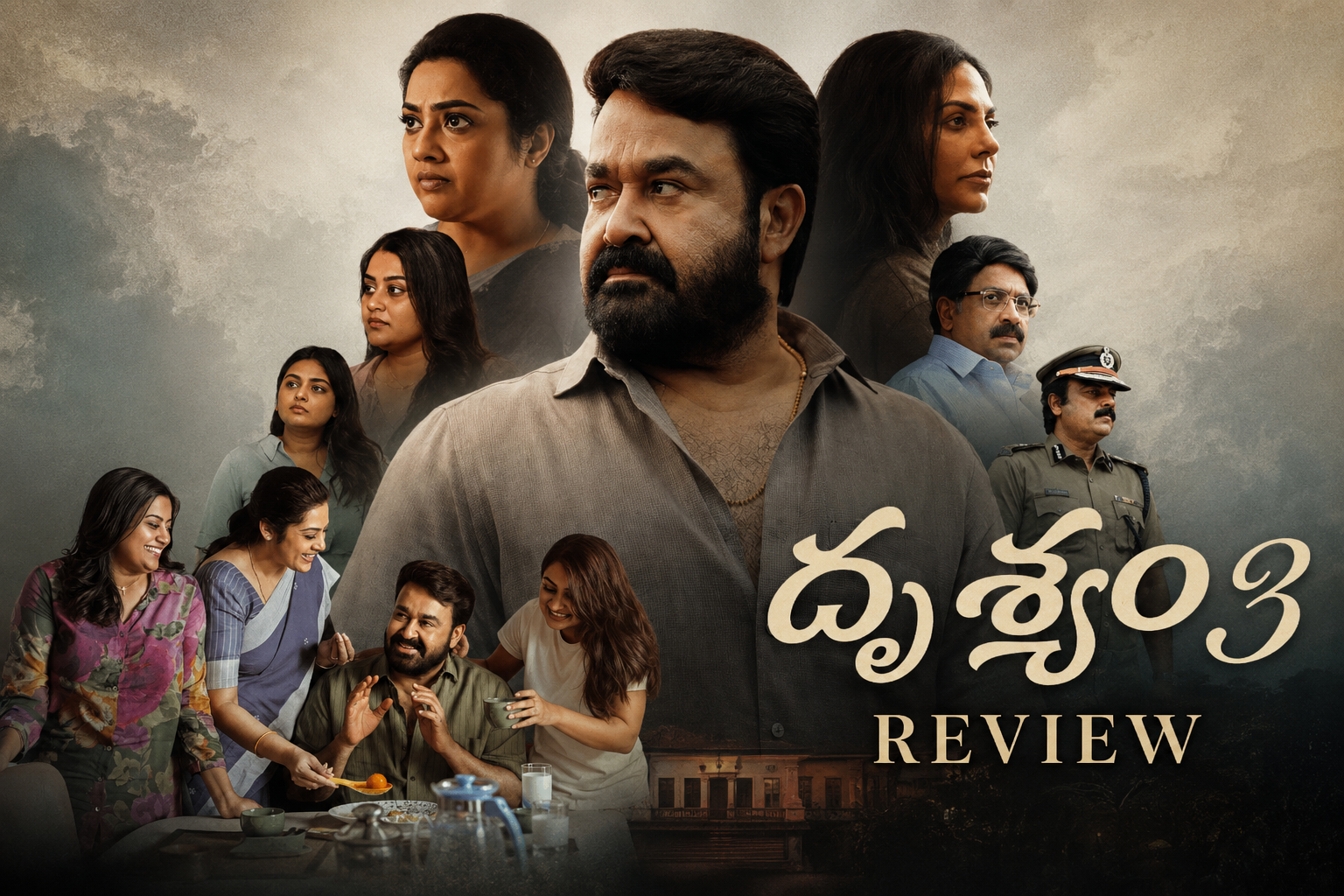
Drishyam 3 is the Malayalam crime thriller everyone who has followed Georgekutty’s story since 2013 has been waiting for. Released worldwide on May 21, 2026, timed to coincide with Mohanlal’s 66th birthday, the film arrives carrying the weight of one of Indian cinema’s most beloved franchises. Written and directed once again by Jeethu Joseph and produced by Antony Perumbavoor under Aashirvad Cinemas, it is confirmed as the final chapter in the trilogy. Mohanlal slips back into Georgekutty effortlessly, and the film has stretches in the second half that remind you exactly why this franchise earned its place in Indian cinema history. But the first half is a long, slow slog, the twists do not hit with the force of either previous film, and the overall experience leaves you feeling that the story had genuinely said what it needed to say in Drishyam 2.
Watch the official Malayalam trailer here: Drishyam 3 Official Trailer – YouTube Watch the official Telugu trailer here: Drishyam 3 Telugu Official Trailer – YouTube
| Detail | Info |
|---|---|
| Movie Name | Drishyam 3 |
| Language | Malayalam (with dubbed releases in Telugu, Tamil, and Kannada) |
| Theatrical Release | May 21, 2026 (Mohanlal’s 66th birthday) |
| OTT Platform | Amazon Prime Video (exclusive digital rights confirmed) |
| OTT Release | Expected late June to early July 2026 |
| Cast | Mohanlal, Meena, Ansiba Hassan, Esther Anil, Asha Sharath, Siddique, Murali Gopy, Santhi Mayadevi, Ganesh Kumar |
| Director | Jeethu Joseph |
| Writer | Jeethu Joseph |
| Cinematography | Satheesh Kurup |
| Editing | V.S. Vinayak |
| Music | Anil Johnson |
| Producer | Antony Perumbavoor |
| Production | Aashirvad Cinemas, Pen Studios, Panorama Studios |
| Budget | Not officially disclosed |
| Advance Booking | Rs. 35.10 crore (second-highest for a Malayalam film ever) |
| Runtime | 2 hours 35 minutes (155 minutes) |
| Certification | Not confirmed at time of writing |
| Hindi Remake | Confirmed for October 2, 2026, directed by Abhishek Pathak with Ajay Devgn |
| Our Rating | 5.5 / 10 |
Is Drishyam 3 Worth Watching?
If you have watched both Drishyam and Drishyam 2, you will watch this regardless of what any review says. That loyalty is earned and understandable. For that audience: yes, watch it, but walk in with considerably lower expectations than either previous film. The second half is strong enough to make the theatre experience worthwhile, and Mohanlal’s presence is always reason enough to sit in a dark room for two and a half hours. But the first half asks too much of your patience, the emotional core of the family feels thinner than it did in either earlier film, and the climax’s major idea lands as clever rather than stunning.
If you have not watched either previous film: stop here, watch Drishyam (2013) and Drishyam 2 (2021) first, and then come back. Drishyam 3 makes no attempt to onboard new viewers, and walking in without knowing Georgekutty’s history will leave you without the emotional context the film depends on entirely.
What Is Drishyam 3 About?
The story picks up approximately four and a half years after the events of Drishyam 2. Georgekutty has moved forward in life in ways that would have surprised anyone who knew him as a cable operator. He is now a film producer, and his debut production has been a success. That detail is not incidental. In Drishyam 2, Georgekutty had plans to make a film based loosely on the events his family survived. In Drishyam 3, that film exists, and the fact that it exists has drawn attention.
His focus at the start of the film is on finding a suitable marriage alliance for his elder daughter Anju. Every proposal that comes close falls apart at the last moment. The reason, while never stated directly, hangs over every scene like smoke. The Varun case, the murder that Georgekutty’s family was involved in and that Georgekutty spent two films protecting them from, has never truly gone away. People know something. They just cannot prove it.
A journalist begins digging. Former officers who were part of the original investigation are still quietly obsessed with what they could not solve. And a therapist enters the orbit of the family in a connection that eventually becomes the film’s most significant thread. Georgekutty, who in the previous films was always the most prepared person in any room, finds himself in a different position in this chapter. He is not the one setting the traps. For much of the film, he is the one walking into them without fully realising it.
That reversal is the film’s most interesting creative choice, and it is also the source of its most significant frustration. Georgekutty on the back foot should generate a different, tighter kind of tension than the films where he was always three moves ahead. The execution only partially delivers on that promise.
What Works
Mohanlal as Georgekutty is still one of Indian cinema’s great screen performances in a specific mode. There is a quieter, more tired version of this character in Drishyam 3. The confidence has not disappeared, but it has been worn by years of vigilance. Mohanlal does not overplay any of that weariness. He lets it sit in the pauses, in the way Georgekutty looks at his daughters, in the way he receives information without reacting. It is a performance of restraint rather than revelation, and that restraint is entirely right for where this character is now.
The second half is significantly stronger than the first. Once the film’s multiple threads begin to pull toward each other, the pacing tightens considerably. There is a specific sequence in the second half involving the psychological element of the story that is the film’s best individual scene and gives the franchise a dimension neither previous film explored. If you sit through the slow first half, the second half earns that patience back to a reasonable degree.
Asha Sharath as Geetha Prabhakar is exceptional. Her character has always been one of the franchise’s most morally complex figures: a mother who lost her son, a police officer who knows she cannot prove what she knows is true, a woman who lives with a grief that has nowhere to go. In Drishyam 3 she is given a thread involving her own psychological state, and Asha Sharath handles it with a rawness and precision that makes every scene she is in the best version of the film.
The mental health thread is genuinely new territory for the franchise. Jeethu Joseph introduces a therapist character whose connection to the family creates unexpected complications. The way that thread unfolds in the second half is the film’s most surprising and emotionally resonant development. It also represents the first time the franchise has seriously engaged with what the psychological cost of living inside this family’s secret might actually look like.
The record-breaking advance booking is a cultural moment. Rs. 35.10 crore in advance sales made Drishyam 3 the second-highest pre-seller in Malayalam film history. That number tells you everything about what this franchise means to audiences who have followed it for thirteen years. Mohanlal celebrated his 66th birthday at the first day first show with fans, and that image of the actor surrounded by the audience he has given so much to is genuinely moving regardless of what the film itself delivers.
Murali Gopy as IG Thomas Bastin returns with the same coiled, controlled menace. His character’s obsession with resolving the case gives the threat an institutional weight that individual antagonists rarely achieve. He is convincing and consistent across all three films.
What Does Not Work
The first half is too slow for too long. Jeethu Joseph has always been a filmmaker who builds tension through accumulation rather than incident. That approach powered two films that deserved every bit of the patience they asked for. In Drishyam 3, the accumulation in the first half does not build to anything proportionate. The drama before the interval is described accurately by critics across publications as not engaging enough. The interval twist itself, when it comes, does not land with the impact it needed because the preceding hour has not built enough momentum to amplify it.
The emotional core of the family feels thinner this time. Meena, Ansiba Hassan, and Esther Anil all reprise their roles with commitment, but the family’s internal emotional dynamics, which gave Drishyam and Drishyam 2 their warmth and specificity, are less fully written in this chapter. The film is more concerned with external threat than with the interior life of the family unit, and that shift costs the story something real.
Georgekutty’s celebrated cleverness is underutilised. Positioning him on the back foot is the right instinct. But the film does not fully replace the satisfaction of watching him outmanoeuvre his opponents with an equally satisfying alternative. When the climax arrives, his response to the situation is clever in a low-key way rather than stunning in the way the franchise’s best moments have been. The major twist in the climax reads as interesting to some critics and merely okay to others. On balance it lands closer to the second description.
The runtime is too long for the story being told. At 155 minutes, the film has approximately thirty minutes of material in the first half that could be removed without losing anything essential. The best parts of the film are all in the final forty minutes. A tighter cut would have made the overall experience considerably more satisfying.
Some secondary characters are too thinly written. The journalist who begins investigating the case, the newer faces in the supporting ensemble, several feel like narrative functions rather than people. In a franchise that has always distinguished itself by giving even its supporting characters genuine interiority, that flatness is noticeable.
The ending suggests the franchise may continue. Jeethu Joseph confirmed in February 2026 that this is the final film in the trilogy. But the closing moments of Drishyam 3 do not fully feel like a conclusion. Some critics and early audiences have read the ending as leaving the door open for further chapters. If this is genuinely the end, the film needed a more decisive final note.
Performances
Mohanlal (Wikipedia) has now played Georgekutty across three films spanning thirteen years of real time and approximately thirteen years of story time. The character has aged, and Mohanlal’s performance reflects that aging without ever feeling like a star performing old age. Georgekutty in Drishyam 3 is a man whose greatest skill has always been staying ahead of everyone else, now discovering that time and circumstance can move faster than even he can. That is a genuinely interesting dramatic position, and Mohanlal inhabits it with the same total ease he brought to the character’s more triumphant moments in earlier films.
Meena (Wikipedia) as Rani is as reliable as she has been in all three films. The writing gives her less room in this chapter than either of the previous ones, and she does not have a scene in Drishyam 3 that matches her strongest moments in parts one and two. She is never less than convincing, but she is also never given the opportunity to be exceptional.
Ansiba Hassan (Wikipedia) as Anju carries the marriage subplot that opens the film, and her scenes with Mohanlal in the first half establish the pressure Georgekutty is operating under as a father who knows that his family’s secret is preventing his daughter from having the life she deserves. It is a quieter performance than the earlier films required of her, and she handles that quietness well.
Esther Anil (Wikipedia) as the younger daughter Anu has grown considerably as a performer since the first film. The mental health thread of the story connects to her character most directly, and the scenes where that thread becomes central to the story’s tension are where she is asked to do the most, and where she delivers most convincingly.
Asha Sharath (Wikipedia) as Geetha Prabhakar is the film’s most complete performance outside of Mohanlal. Her character’s grief and obsession have always been the emotional counterweight to Georgekutty’s survival, and in this final chapter she is given material that brings both of those qualities to a painful clarity.
Siddique as Prabhakar and Murali Gopy as IG Thomas Bastin are both as effective as they have been across the franchise.
Direction, Writing and Technical Elements
Jeethu Joseph has built something genuinely rare in Indian cinema with this franchise. A crime thriller that ran across three films over thirteen years, maintained its tonal consistency throughout, and sustained audience investment even between very long gaps. That achievement should not be undersold regardless of where Drishyam 3 lands relative to its predecessors.
What is apparent in Drishyam 3 is that the story had naturally concluded in Drishyam 2, and bringing it back for a third chapter required either a completely new dramatic premise or a very compelling reason rooted in the characters to continue. The mental health thread and the reversal of Georgekutty’s usual position are both valid ideas. The execution, particularly in the first half, does not match the quality of those ideas. The screenplay does not find a strong enough engine for the first hour, and the film pays for that in the most critical period of any cinema experience, when the audience is forming its relationship with the version of the story this chapter intends to tell.
Satheesh Kurup’s cinematography is understated and appropriate. Anil Johnson’s music serves the material without distinguishing itself. V.S. Vinayak’s editing is the film’s most significant technical limitation. A tighter cut that removed thirty minutes from the first half would have produced a substantially better film.
The Franchise in Context
Drishyam (2013) was a revelation. A Malayalam film built entirely on the premise that a man with no formal training but extraordinary practical intelligence could outwit an entire police investigation through sheer preparation. The film trusted its audience completely and was rewarded with one of the most enthusiastic critical and commercial receptions in recent Malayalam cinema history.
Drishyam 2 (2021), released during the pandemic period, did something that sequels rarely manage: it matched the original on its own terms and extended the story in a way that felt necessary rather than commercial. The question of whether Georgekutty could survive a new investigation with a new officer who was smarter and more determined than the original gave the sequel genuine dramatic stakes.
Drishyam 3 does not have a question of comparable weight at its centre. The threat exists, the tension is real in the second half, and the ending offers a kind of closure. But the film does not add a new dimension to Georgekutty’s story the way Drishyam 2 did. It extends it. Those are different things, and the difference is why Drishyam 3, while watchable and occasionally genuinely good, sits clearly below both its predecessors.
Frequently Asked Questions
Is Drishyam 3 worth watching in theatres?
Yes, if you have followed the franchise from the beginning. Walk in with lower expectations than either previous film and you will find the second half rewarding. If you have never watched the earlier films, watch those first.
Is Drishyam 3 the final film in the franchise?
Jeethu Joseph confirmed in February 2026 that this is the final chapter of the trilogy. However, some audience members have read the ending as leaving room for continuation.
Do I need to watch Drishyam and Drishyam 2 first?
Yes, absolutely. Drishyam 3 assumes complete familiarity with the previous films and makes no effort to catch up new viewers. Watching it without that context will significantly reduce the emotional impact of everything that happens.
When will Drishyam 3 release on OTT?
Amazon Prime Video holds the exclusive digital rights. Based on the standard four-week theatrical window, the OTT release is expected in late June to early July 2026.
Is Drishyam 3 available in Telugu?
Yes. The film released simultaneously in Malayalam, Telugu, Tamil, and Kannada.
Who is the villain in Drishyam 3?
Drishyam 3 does not have a single traditional villain. The threat comes from multiple directions including a journalist, former officers, and circumstances Georgekutty has not fully anticipated.
Is the Hindi remake of Drishyam 3 confirmed?
Yes. The Hindi remake is confirmed for October 2, 2026, directed by Abhishek Pathak with Ajay Devgn reprising his role as Vijay Salgaonkar alongside Tabu and Shriya Saran.
What is the runtime of Drishyam 3?
2 hours and 35 minutes (155 minutes).
What was the advance booking collection for Drishyam 3?
Rs. 35.10 crore in advance bookings, making it the second-highest pre-seller in Malayalam cinema history.
Final Verdict
CinemaCelebs Rating: 5.5 / 10
Drishyam 3 is a film caught between the weight of its own legacy and the creative limitations of a story that had already reached its natural conclusion. Mohanlal gives the character everything it needs and more. Asha Sharath delivers the franchise’s finest individual performance in this third chapter. The mental health thread and the reversal of Georgekutty’s position are genuinely fresh ideas. And the second half, once the film finds its footing, generates the kind of slow-building tension that made the original so special.
But the first half is too long and too underpowered, the family’s emotional dynamics are thinner than either previous film allowed, and the climax, while clever, does not produce the jaw-dropping moment the franchise has trained its audience to expect. Drishyam 3 is a decent film that follows two great ones. In a franchise defined by its intelligence, decent is the most disappointing possible verdict.
Watch it if: You have followed Georgekutty’s journey from the beginning and need to see it through to the end. The second half alone makes the theatre experience worthwhile for a dedicated franchise audience.
Skip it if: You are looking for the same tension and intelligence the first two films delivered from beginning to end, or you have not yet watched Drishyam and Drishyam 2.