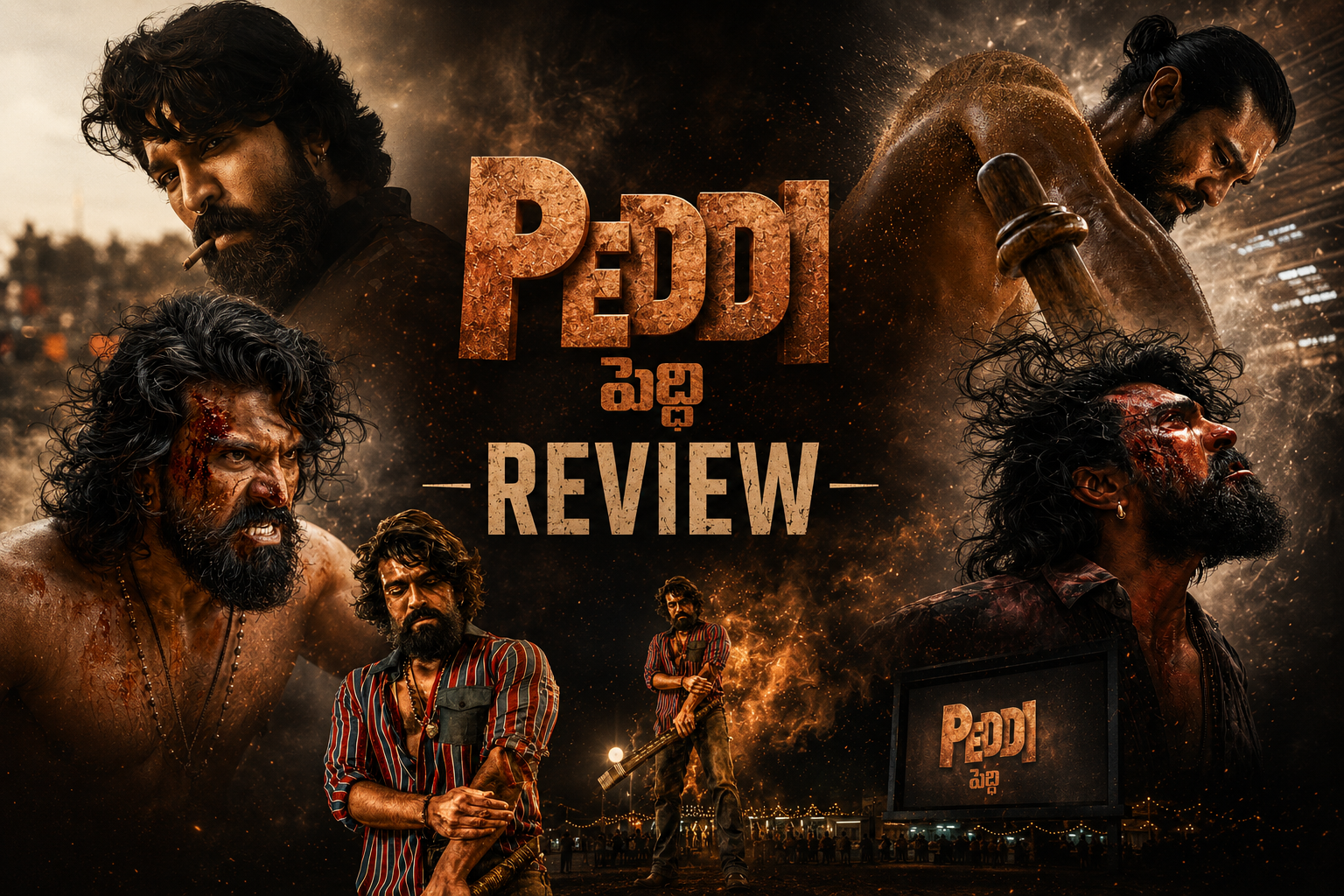
Peddi is the kind of film where the lead actor is working at a level the screenplay around him never quite matches. Ram Charan gives the best performance of his career in Buchi Babu Sana’s rural sports drama, and for long stretches that is enough to hold a 189 minute film together. If you came for Charan, you will leave satisfied. If you came for a tight script, you will notice the seams. It hit theatres worldwide on June 4, 2026, and heads to Netflix after its theatrical run.
| Detail | Info |
|---|---|
| Movie Name | Peddi |
| Language | Telugu |
| Theatrical Release | June 4, 2026 |
| OTT Release | After theatrical run |
| Platform | Netflix |
| Audio Languages | Telugu, Hindi, Tamil, Kannada, Malayalam |
| Cast | Ram Charan, Janhvi Kapoor, Shiva Rajkumar, Jagapathi Babu, Divyenndu, Boman Irani |
| Director | Buchi Babu Sana, in his second film after Uppena |
| Music | A. R. Rahman |
| Cinematography | R. Rathnavelu |
| Editing | Naveen Nooli |
| Production | Mythri Movie Makers, Sukumar Writings, Vriddhi Cinemas |
| Runtime | 189 minutes |
| Certification | UA |
| Our Rating | 7 / 10 |
Is Peddi Worth Watching?
Yes, if you watch Telugu cinema for performance and emotional payoff and you can sit through a first half built almost entirely from familiar mass-film parts. Ram Charan is the reason to buy a ticket, and the second half rewards your patience with a genuine emotional climb. Viewers who want a disciplined sports drama with a lean runtime will find this one baggy and padded, especially in its romance track.
What Is Peddi About?
Peddi is a young man from a village in the Vizianagaram belt that does not officially exist on any government record. He works in a jaggery factory and earns extra money as a cricketer-for-hire, playing for whichever local team pays him that week. He is freakishly talented across more than one sport, and the film frames his story through an outsider, Paiswal, played by Boman Irani, who arrives to understand who this man is and where he came from.
The setup turns when Appalasuri, the figure who has been fighting for the village’s recognition, dies on the railway tracks during that fight. The loss reshapes Peddi. He decides he will not only win his village a railway station but also force the country to acknowledge that these people exist at all. His route to that goal runs through sport.
The second half is about how a cricketer-for-hire becomes a crossover athlete, moving into wrestling and eventually running, and uses that talent as leverage to drag national attention toward a place the system forgot. The film stays interested in the dignity question right up to the end, which is where it earns most of its goodwill.
What Works
Ram Charan is operating at a different level. This is the most complete work of his career, ahead of even Rangasthalam in range. The Uttarandhra dialect lands as authentic rather than performed, and the physical transformation across cricketer, wrestler and runner is the rare case where the makeover serves the character instead of the poster. He holds the frame in quiet emotional scenes as confidently as he does in the mass moments, which is harder than it looks.
The wrestling training stretch is the film’s high point. This is where the crossover athlete idea is actually explored rather than just stated. The training and the wrestling bout are choreographed with real craft, and dropping a grappling contest into a film full of standard action gives the second half a jolt the cricket scenes never quite manage.
The interval block does its job. It is predictable on paper, but the runup and the interval bang are staged with enough conviction to set up the second half and send the audience back in invested. Buchi Babu knows how to build a commercial high point.
A. R. Rahman’s songs are genuine chartbusters. “Chikiri Chikiri” and “Rai Rai Ra Ra” carry real energy and lift the narrative when they land in the right spots. The soundtrack was a hit before release and the placement mostly justifies it.
The climax delivers the emotional payoff. The pre-climax and climax are where Charan’s restraint and the village’s stakes finally pull together, and Buchi Babu wisely ends the film while that feeling is still fresh rather than overstaying it.
What Does Not Work
The romance track is filler. Every time Janhvi Kapoor’s character enters in the first half, the pace and intensity drop. The thread does not feed the core story of village recognition, and the film keeps pausing for it instead of building momentum. The writing gives her almost nothing to push against.
The runtime is the central problem. At 189 minutes, Peddi is carrying weight it does not need. The first half in particular leans on heroism beats and elevation moments to fill space, and several emotional scenes that should land hard feel ordinary because the writing and pacing dilute them. A tighter edit would have made this a sharper film.
Most of the supporting cast is wasted. The film is packed with actors who appear, register for a moment and vanish without leaving a mark. Jagapathi Babu’s Appalasuri tips into melodrama in places, which undercuts a character whose death is meant to be the emotional engine of the whole story.
The cricket sequences look good and feel flat. They are shot competently, but outside of Charan’s presence they lack the wow factor a sports film needs from its central game. The wrestling works precisely because it is the exception.
Performances
Ram Charan: The film rests on him and he carries it without strain. He is convincing as the cocky cricketer-for-hire early on and even better in the back half, where the role asks for emotional maturity rather than swagger. The scenes around the pre-climax are his strongest, and they are the moments most likely to stay with you on the drive home.
Janhvi Kapoor: She is fine within a part that gives her very little to do. The character is written as a romantic placeholder rather than a person with her own stake in the story, and no performer overcomes a role built that thin. The fault here is on the page, not on her.
Shiva Rajkumar: He leaves a strong impression with limited screen time, particularly in the wrestling mentor stretch. His presence gives that whole section gravity. Jagapathi Babu has the showier role as Appalasuri but is let down by writing that pushes him toward melodrama. Divyenndu and Boman Irani are functional, with Irani’s narrator framing serving the structure more than it serves him as an actor.
Direction, Writing and Technical Elements
Direction: Buchi Babu’s instinct for emotional groundwork is intact from Uppena. He establishes the plight of the unrecognised village and the homeless labourers with care, and that foundation is what lets the second half work. His weakness here is structural. He builds a strong emotional base and then spends too long decorating it with commercial filler before he lets the real story move.
Writing: The script is built on a clear commercial-plus-emotional blueprint, with heroism, sacrifice, victories and defeats all slotted in where a mass audience expects them. The dignity-and-recognition spine is genuinely strong. The romance and the bloated first hour are where the writing gives way, and a few key emotional beats are underwritten enough that they pass without the impact they were designed for.
Technical: Rahman’s songs are the headline, and his background score does real work in the climax. R. Rathnavelu’s camera handles the village and the sporting set pieces well. Naveen Nooli’s editing is the place to point at when discussing the runtime, since several portions in both halves could have been trimmed for a crisper, harder-hitting film.
How Does Peddi Compare?
The most useful comparison is to Rangasthalam, also a Ram Charan film rooted in a specific rural Andhra texture. Rangasthalam wove its hero’s personal arc and its larger social fight into a single tight thread, so the emotion and the cause moved together. Peddi keeps those two strands more separate, which is why the village-recognition story hits and the romance does not. When Buchi Babu lets the social stakes drive Charan’s character, the film is as strong as anything in that space. When he steps away to service mass-film convention, it sags. The talent to make a Rangasthalam-level film is clearly here. The discipline to cut everything that does not serve it is not, at least not yet.
Frequently Asked Questions
Is Peddi worth watching on Netflix?
Yes, especially for Ram Charan’s career-best performance and a strong emotional climax. Go in expecting a slow, commercial first half before the film finds its footing.
What is Peddi about?
A talented young man from an unrecognised village uses his sporting ability across cricket, wrestling and running to fight for his community’s dignity and a railway station, forcing the country to acknowledge that his people exist.
Is Peddi available in Telugu, Tamil, Hindi or Malayalam?
Yes. Peddi released in Telugu, Hindi, Tamil, Kannada and Malayalam in theatres, and the same audio options are expected when it streams on Netflix after its theatrical run.
Who directed Peddi?
Buchi Babu Sana, making only his second feature after the 2021 hit Uppena.
What is the rating of Peddi?
Certified UA, with a CinemaCelebs rating of 7 out of 10. The score reflects an outstanding lead performance held back by an overlong, uneven screenplay.
Is Peddi based on a true story?
No. It is an original story written by Buchi Babu Sana, though it draws on the real issue of unrecognised and neglected villages.
How long is Peddi?
189 minutes, and it does not fully earn that length. The first half in particular could lose twenty minutes without losing anything that matters.
Why is Ram Charan’s performance in Peddi getting so much attention?
Because it goes beyond his usual mass-hero register. The dialect work, the multi-sport physical transformation and the restraint in the emotional scenes mark it as a real step up in range.
Final Verdict
CinemaCelebs Rating: 7 / 10
Peddi is a good film with a great central performance trapped inside a screenplay that needed a harder edit. The core idea, a forgotten village fighting to be seen through one man’s sporting talent, is genuinely moving when the film commits to it, and Ram Charan gives it everything. The cost is a padded first half, a romance that goes nowhere and a runtime that tests patience before the payoff arrives. It does not fully earn its 189 minutes, but the climax earns your forgiveness for most of them.
Watch it if: You follow Ram Charan and want to see him do his most committed dramatic work to date in a story with real emotional stakes.
Skip it if: You have low tolerance for long, commercial-formula first halves and filler romance tracks and you want your sports dramas lean.
Peddi is in theatres now in Telugu, Hindi, Tamil, Kannada and Malayalam, and will stream on Netflix after its theatrical run.