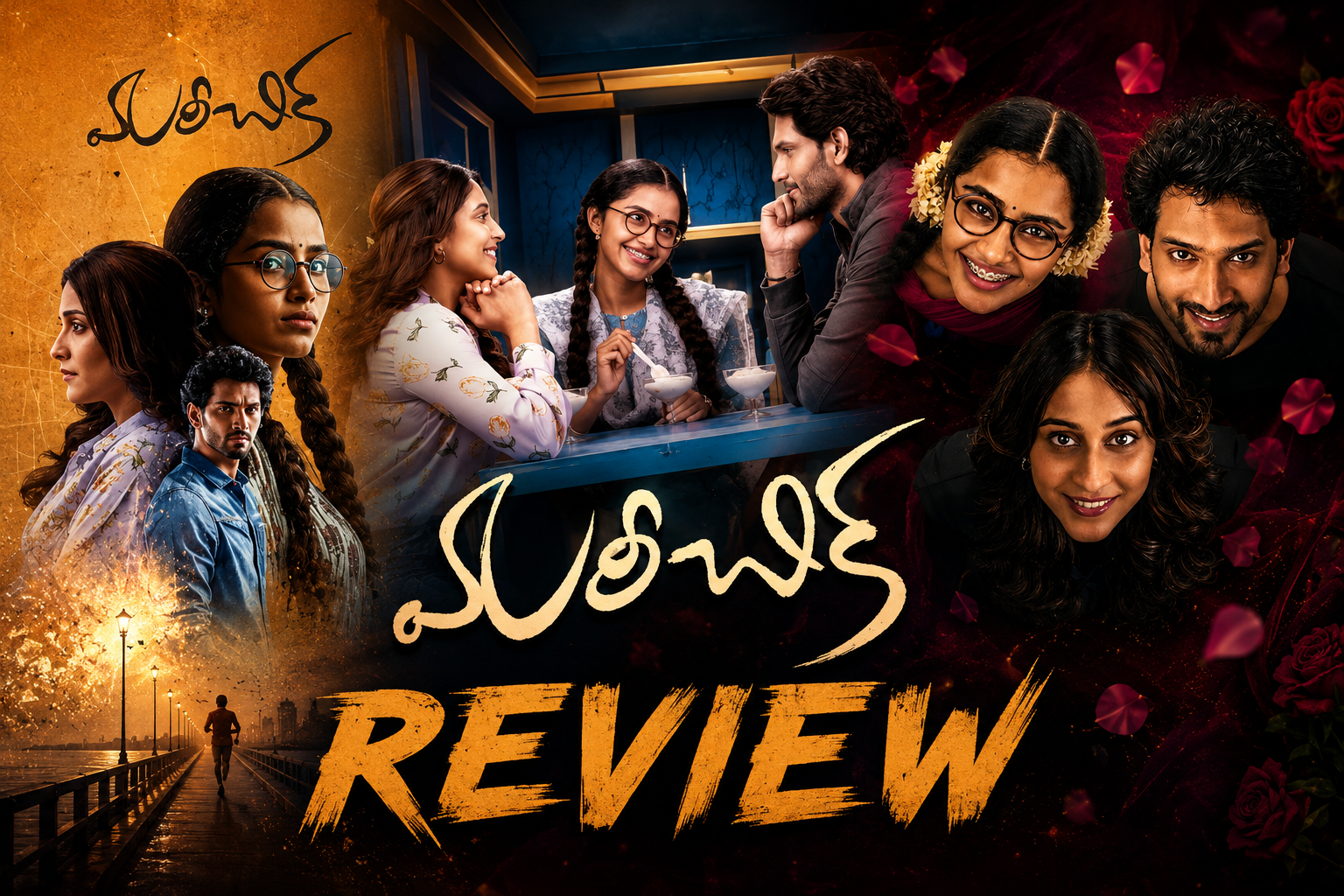
Mareechika is a Telugu psychological thriller that has a genuinely good idea sitting at its centre and never quite figures out how to spring it on you. It’s in theatres now, and it’s worth a look mainly if you came for Anupama Parameswaran and a twisty hook rather than a tight, propulsive mystery. The concept deserved a leaner film than the one that got made.
| Detail | Info |
|---|---|
| Movie Name | Mareechika |
| Language | Telugu |
| Theatrical Release | May 29, 2026 |
| OTT Release | Not yet announced |
| Platform | In theatres |
| Audio Languages | Telugu |
| Cast | Viraj Ashwin, Regena Cassandrra, Anupama Parameswaran, Ajay Ghosh |
| Director | Satish Kasetty, who also goes by Kasetty Sathyanarayan |
| Music | Ilaiyaraaja |
| Cinematography | Arvind Kannabiran |
| Editing | Junaid Siddiqui |
| Production | Chilaka Productions |
| Runtime | 138 minutes |
| Certification | UA (to be confirmed) |
| Our Rating | 5 / 10 |
Is Mareechika Worth Watching?
If you like psychological thrillers built on an identity puzzle and you can forgive a slow build, there’s enough here to hold you, especially Anupama Parameswaran in a role that lets her play both warmth and something darker. If you want a thriller that moves, that keeps tightening, that lands its reveal cleanly, this isn’t it. The film has the bones of a smart movie and the pacing of a much weaker one.
What Is Mareechika About?
Venkatalaxmi, a college student played by Anupama Parameswaran, is quietly in love with Sanju, a corporator’s son who has walked away from the easy money to run his own coffee shop. She never says any of this out loud. Instead she befriends Mareechika, an NRI woman who has just come back from the US, and watches the two of them grow close.
Then they marry. And then Mareechika kills Sanju. Venkatalaxmi walks into a police station and the investigation begins, which is where the film wants to live: in the gap between what happened and why.
The question of who Mareechika really is, and what Venkatalaxmi knows, is the engine of the second half. The premise has a real twist in it. Saying more would spoil the one thing the film is built to protect.
What Works
Anupama Parameswaran carries the film. She’s asked to play a character with positive and negative shades inside the same frame, and she finds the line. Her de-glam look fits the part, and the police station scenes give her the most room. The emotional shifts there are the most convincing acting in the movie.
The core idea is genuinely interesting. Writer Lakshmi Bhupala has a hook that, on paper, sits in the same psychological-identity space as One: Nenokkadine. That ambition is real. The film is reaching for something more than a routine whodunit, and you can feel the intent even when the execution lets it down.
Ilaiyaraaja’s score knows when to recede. The music doesn’t oversell the tension. In a film this reliant on mood, that restraint matters, and it’s one of the few craft choices that consistently helps the story instead of crowding it.
What Does Not Work
The reveal is staged with confusion instead of clarity. A psychological thriller lives or dies on how cleanly it lets you understand the trick once it’s sprung. Here the suspense unfolds in a muddle. Information arrives in the wrong order and at the wrong temperature, so the payoff lands as a shrug rather than a jolt. The idea is smarter than the way the film hands it to you.
The pacing sags on both ends of the interval. The first half takes too long to get moving, and the second half doesn’t pick up the slack the way a thriller this size needs to. Long stretches pass without a scene that pushes the mystery forward.
The investigation scenes are weak. For a film that depends on a police inquiry to deliver its biggest beats, the procedural side is thin. Ajay Ghosh’s character is written for comic confusion, and the trouble is the audience ends up confused alongside him, but not in the fun way the film intends.
Performances
Anupama Parameswaran is the reason to watch. She holds the centre even when the screenplay gives her static scenes, and the emotional range she finds in the station sequences is harder than it looks. This is the performance the film will be remembered for.
Regena Cassandrra looks right as the woman just back from the US, and she’s fine in the lighter beats, but the role asks for more variation than she brings. The performance stays on one note where the story needs shading.
Viraj Ashwin is comfortable as the romantic lead and looks the part. He’s less convincing in the scenes that call for cunning, where you need to feel the character calculating, and that’s where the writing and the performance both come up short. Ajay Ghosh, Vadlamani Srinivas and Thagubothu Ramesh fill out the supporting cast competently without anyone breaking through.
Direction, Writing and Technical Elements
Director Satish Kasetty clearly wanted to make something other than a by-the-numbers Telugu thriller, and that instinct is worth respecting. The problem is control. A thriller built on a twist needs a director shaping every reveal, and Kasetty struggles to keep the screenplay moving at the clip the genre demands.
On the writing, Lakshmi Bhupala’s story has a strong spine and a weak skeleton around it. The idea is there. The scene-to-scene construction that should make that idea sing is not. Too many sequences exist to delay rather than to build.
Technically, Arvind Kannabiran’s camera handles the Hyderabad setting without showing off, Junaid Siddiqui’s edit can’t fully rescue the pacing the script hands it, and Ilaiyaraaja’s score is the steadiest hand in the room.
How Does Mareechika Compare?
The film’s own ambition invites the comparison to One: Nenokkadine, since both reach for a psychological premise where identity itself is the mystery. The difference is in the staging. Nenokkadine kept you oriented even at its most disorienting, so the unraveling felt like a controlled descent. Mareechika loses that grip. It has a comparable idea and nowhere near the same command of how to dole it out, which is exactly the gap between a thriller that grips and one that merely intrigues.
Frequently Asked Questions
Is Mareechika worth watching in theatres?
It’s a one-time watch for fans of psychological thrillers and for Anupama Parameswaran’s performance. Viewers wanting a fast, tightly plotted mystery will likely feel let down by the pacing.
What is Mareechika about?
A college student in love with a coffee shop owner watches him marry her NRI friend, who then kills him. The film follows the police investigation into why it happened and who the killer really is.
Is Mareechika available in Telugu / Tamil / Hindi / Malayalam?
Mareechika released theatrically in Telugu. No other audio language versions have been confirmed at the time of writing.
Who directed Mareechika?
Satish Kasetty, also known as Kasetty Sathyanarayan, directed the film from a script by Lakshmi Bhupala.
What is the rating of Mareechika?
Our rating is 5 out of 10. That score reflects a strong central performance and an interesting premise undone by slack pacing and a muddled reveal.
Is Mareechika based on a true story?
No. It’s an original psychological thriller.
How long is Mareechika?
The runtime is 138 minutes, and the film does not fully earn that length given how slowly the first half moves.
Where can I watch Mareechika?
Mareechika is currently in theatres. An OTT premiere has not been announced yet.
Final Verdict
CinemaCelebs Rating: 5 / 10
Mareechika is the frustrating kind of average, the kind where you can see the good film hiding inside the mediocre one. The premise is sharp, Anupama Parameswaran is genuinely good, and Ilaiyaraaja’s score holds its nerve. But the pacing drags, the investigation scenes are thin, and the reveal arrives in a confused heap instead of a clean strike. It doesn’t fully earn its 138 minutes.
Watch it if: You follow psychological thrillers and want to see Anupama Parameswaran stretch into a layered role.
Skip it if: You need a thriller that moves fast and pays off its mystery cleanly.
In theatres now in Telugu. No OTT release announced yet.