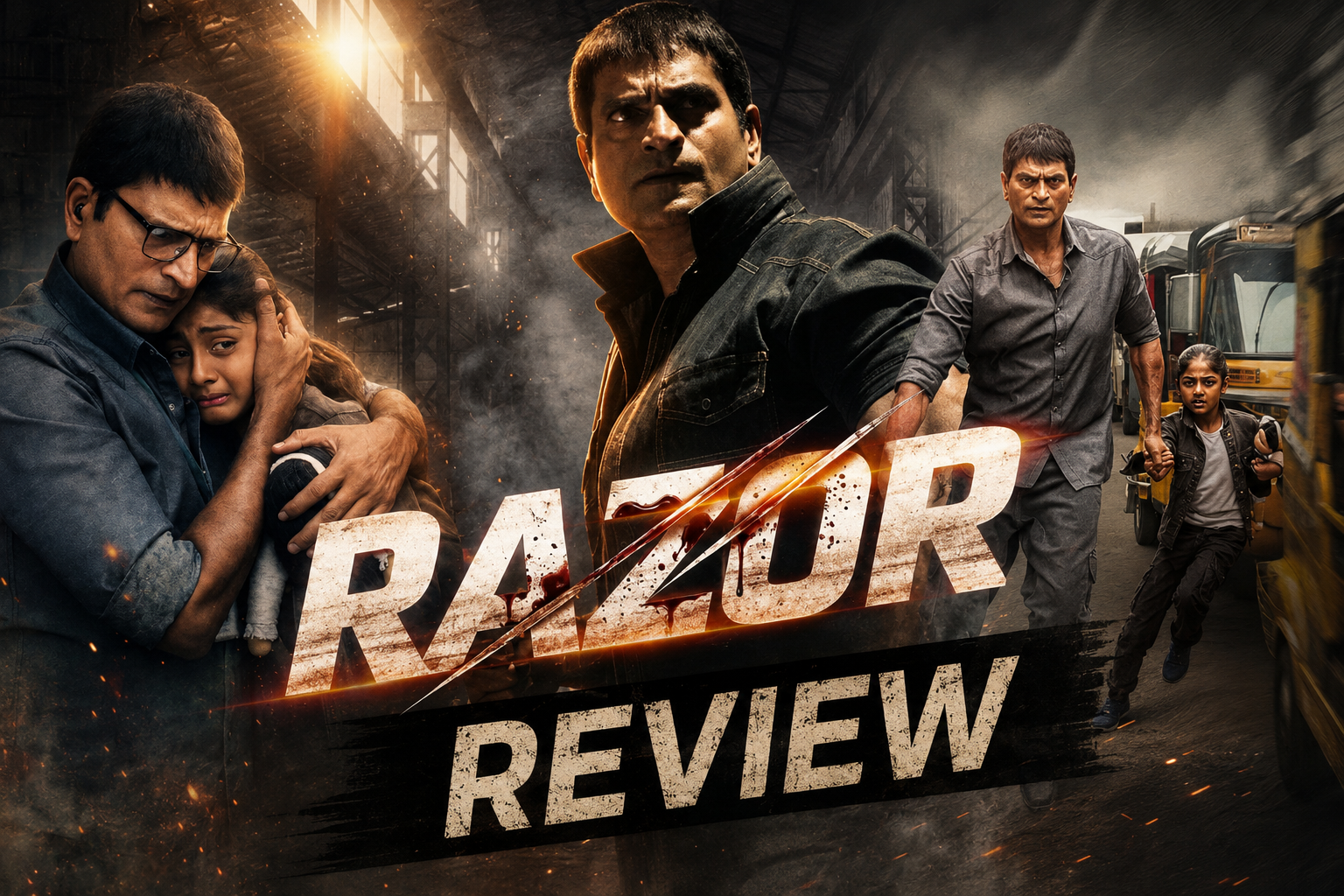
Razor is a Telugu action thriller releasing worldwide on May 8, 2026, written and directed by Ravi Babu, who also plays the lead role. Presented by Suresh Productions and produced by Flying Frogs, the film marks a sharp creative departure from Ravi Babu’s previous lighter-toned work. It is also the most graphic and unfiltered film he has made in his career. Released on the birth anniversary of his father, the late Chalapathi Rao, Razor is a film that demands a specific kind of viewer. If brutal, psychologically intense Telugu thrillers are your territory, this is one of the most committed examples the industry has produced in recent memory.
Watch the official trailer here: Razor Official Trailer – YouTube
| Detail | Info |
|---|---|
| Movie Name | Razor |
| Language | Telugu |
| Theatrical Release | May 8, 2026 |
| OTT Release | Not announced yet |
| Platform | Theatre |
| Cast | Ravi Babu (lead), supporting cast not widely publicised |
| Director | Ravi Babu |
| Music | SS Rajesh |
| Cinematography | Charan Madhavaneni |
| Action Choreography | Satish Poloju |
| Production | Flying Frogs |
| Presenter | Suresh Babu / Suresh Productions |
| Runtime | 2 hours 10 minutes |
| Certification | A (Adults Only) |
| Release Date Significance | Birth anniversary of Chalapathi Rao, Ravi Babu’s father |
| Our Rating | 6 / 10 |
Is Razor Worth Watching?
If you are a fan of Ravi Babu’s dark genre work, specifically Avunu and Anasuya, and you have no problem with a film that is certified A for a strong reason, then yes. Razor is the most technically focused and emotionally sustained thriller Ravi Babu has made in over a decade. It is not a film for general audiences or for families. The violence is explicit, the tone is relentlessly grim, and the film does not soften any of its edges. But within those parameters, it is a well-crafted, genuinely tense piece of cinema.
What Is Razor About?
A young girl becomes the target of a powerful politician and his sprawling criminal network. The reasons behind the threat are not immediately made clear. What is clear from the opening sequences is that the danger is real, immediate, and backed by money and influence that the legal system cannot challenge. The girl has no ally and no way out.
Into this situation steps Ravi Babu’s character, a man described in some pre-release material as an unassuming dog groomer with a violent history. He is not presented as a traditional hero with noble motives. He is a man who has made peace with brutality and is willing to weaponise it to protect the child. The film positions him not as a saviour but as something rawer than that, a force that was always dangerous and now has a direction.
The corrupt politician is the primary antagonist, and the film’s central tension is built around whether Ravi Babu’s character can protect the girl long enough for the stakes to be revealed. The screenplay keeps you inside the danger. Every location they move through feels like a potential trap, and the film does a good job of making the sense of being hunted feel genuine rather than performed.
What Works
Ravi Babu’s performance as the guardian. He builds the character from the ground up without leaning on any of the audience-friendly shortcuts a less confident actor-director combination would have used. His character is rough, cold, and not particularly easy to root for in the conventional sense. The warmth he develops toward the child is earned slowly, and the gradual shift from cold professional to something resembling protective instinct gives the film its emotional architecture.
The sense of constant threat. Ravi Babu the director makes very specific choices about how to keep the audience inside the danger. He uses tight camera angles to create a feeling of being enclosed. He lets scenes breathe without sound before a violent event, using silence as a warning. He keeps the criminals visible just enough to maintain dread without overexplaining their movements.
The villain’s design. The politician antagonist does not shout or rage. He speaks quietly and gives instructions with the calm of someone who has never faced consequences. That register makes him considerably more menacing than a screaming antagonist would be, and the performance sustains it throughout.
Charan Madhavaneni’s cinematography. The visual world of Razor is deliberately dark, shadow-heavy, and industrial. Even daytime scenes are shot to suggest something unsafe just out of frame. The lighting choices work with the material rather than against it, and there are individual frames in the film that hold the eye beyond their narrative function.
The child actor and actor chemistry. The relationship between Ravi Babu’s character and the young girl is the film’s emotional core, and it works because neither performer overplays it. The child is not written as a prop or a symbol. She is written as a frightened person who gradually learns to trust, and that development gives the film’s action sequences a weight they would not otherwise have.
The scale compared to Ravi Babu’s earlier work. His horror and thriller films of the 2000s operated in contained, small-scale settings. Razor is dealing with a systemic corruption angle, a criminal network rather than a single killer, and Ravi Babu handles that expanded canvas with more confidence than his detractors would have expected.
What Does Not Work
The A certification is a genuine barrier for wider reach. The pre-release title glimpse and trailer were graphic enough to trigger strong reactions, including some prominent voices calling the violence tasteless and gratuitous. Whether that reaction is fair is something individual viewers will judge for themselves, but the certification limits the audience significantly. A film built around protecting a child and exposing political corruption could have reached a much wider cross-section of viewers if the violence had been calibrated to a UA level without losing impact.
The supporting cast is thin on recognition. Ravi Babu made a deliberate choice not to involve well-known actors beyond himself, and that choice suits the film’s raw, unglamorous aesthetic. But it also means the film has to work harder to establish credibility for its supporting characters, and in a few cases the performances are not strong enough to do that work effectively.
The first act takes time to earn investment. The film is slow to establish what exactly the girl did or witnessed that put a target on her. The deliberate pace of that revelation creates sustained dread but also demands patience that not every viewer will have in the early scenes.
SS Rajesh’s background score is adequate but not distinctive. A thriller of this register needed a score that could match the visual intensity, and while the music does its job functionally, it does not elevate sequences the way GV Prakash’s score elevated Kara or the way a more imaginative composer might have found a sonic identity for this material.
Direction and Technical Elements
Ravi Babu’s trajectory as a filmmaker has been uneven. The work he did between 2003 and 2012, Allari, Nuvvila, Avunu, and Anasuya, showed genuine ability to build tension and manage genre. The years after that saw a decline that was widely noted. Razor represents a clear recommitment to the territory where he is most effective.
The technical choices throughout are purposeful rather than decorative. The tight angles, the shadow-heavy cinematography, the minimal dialogue in the opening act, all of these are deliberate. The screenplay keeps its mystery intact long enough for the audience to be genuinely curious rather than simply impatient. The action choreography by Satish Poloju is grounded and specific. There are no impossible physical feats. The violence feels like it has physical cost, which is exactly the right approach for a film making claims about how dangerous this world is.
The film was shot wrapped in February 2026, with all post-production and dubbing completed well ahead of the theatrical release. That clean production timeline shows in the finished film. It does not have the rough edges of a rushed delivery.
Frequently Asked Questions
Is Razor suitable for all audiences?
No. The film is certified A, meaning adults only. It contains graphic violence including brutal kills and strong psychological intensity. It is not appropriate for children or general family audiences.
Who directed Razor?
Ravi Babu wrote and directed the film. He is also the lead actor. He previously directed Avunu, Anasuya, and Enuguthondam Ghatikachalam.
What is Razor about?
A young girl hunted by a powerful politician’s criminal network finds an unlikely protector in a man with a violent past who steps up as her guardian.
Why was Razor released on May 8?
The date coincides with the birth anniversary of Ravi Babu’s father, the late actor and comedian Chalapathi Rao, who was one of Telugu cinema’s most beloved character performers.
Who is presented by for Razor?
Suresh Babu presents the film under Suresh Productions. It is produced by Flying Frogs.
When will Razor release on OTT?
No OTT platform or release date has been announced as of May 8, 2026.
What is Razor’s runtime?
2 hours and 10 minutes, certified A (Adults Only) by the Indian Censor Board.
Final Verdict
CinemaCelebs Rating: 6 / 10
Razor is not for everyone, and it does not try to be. It is a dark, brutal, and technically focused Telugu thriller that represents Ravi Babu returning to the creative space where he has always been at his most interesting. The central dynamic between his character and the child he protects gives the film a genuine emotional grounding. The villain is well-designed, the cinematography is committed, and the sense of sustained threat is maintained with real skill across the runtime. The A certification and the graphic content will limit its audience, and some of the supporting work is thinner than the lead performance deserves. But as a piece of genre filmmaking from one of Telugu cinema’s most unconventional voices, it earns its place.
Watch it if: You are a committed fan of Ravi Babu’s thriller work or a Telugu cinema watcher who values grounded, uncompromised genre filmmaking over mainstream formula.
Skip it if: Graphic violence, dark psychological tone, and an A-certified viewing experience are not what you are looking for this weekend.