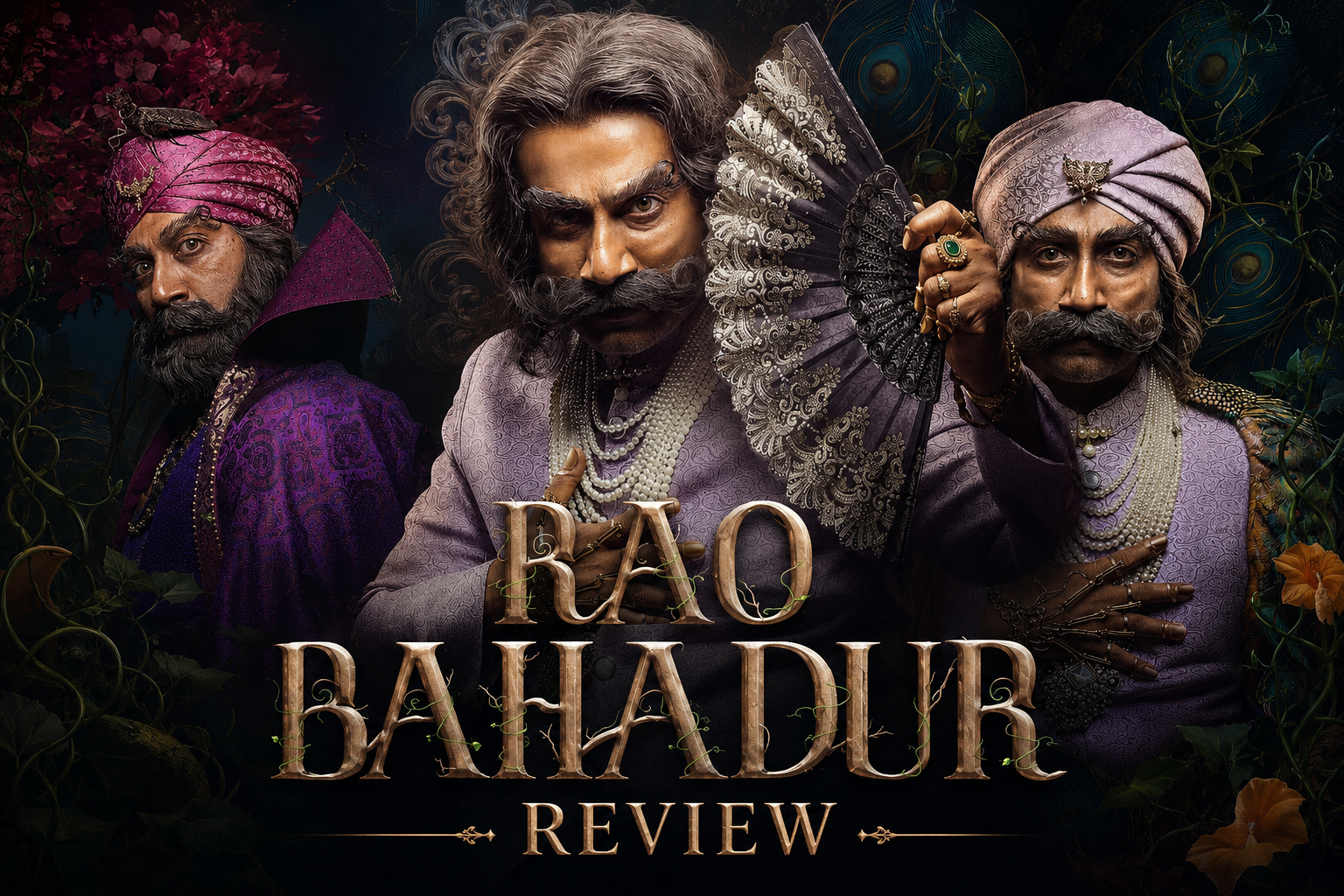
Rao Bahadur is a Telugu psychological drama built around a dying aristocrat’s unresolved past, and it demands more patience from its audience than almost any mainstream Telugu release this year. If you go in for a slow, dialogue-driven film with something real to say about caste and inherited privilege, the second half rewards you. If you need the first half to hold your attention on its own terms, be warned: it doesn’t, for a long stretch.
| Detail | Info |
|---|---|
| Movie Name | Rao Bahadur |
| Language | Telugu |
| Theatrical Release | July 3, 2026 (limited) |
| OTT Release | Not yet announced |
| Platform | In theatres |
| Audio Languages | Telugu |
| Cast | Satyadev, Deepa Thomas, Vikas Muppala, Anand Bharathi, Bala Parasar, Pranay Vaka, Kunal Kaushik |
| Director | Venkatesh Maha (C/o Kancharapalem) |
| Music | Smaran Sai |
| Cinematography | Kartik Parmar |
| Editing | Venkatesh Maha |
| Production | A+S Movies, Srichakraas Entertainments, Mahayana Motion Pictures, presented by GMB Entertainment |
| Runtime | 170 minutes (2 hours 50 minutes) |
| Certification | UA |
| Trailer | Watch the official trailer |
| Our Rating | 5 / 10 |
Is Rao Bahadur Worth Watching?
Worth it if you’re specifically drawn to slow-burn, conversation-heavy films that use satire and magical realism to talk about caste and bloodline, and you’re willing to sit through a genuinely testing first half to get there. Not for anyone looking for a conventional Satyadev commercial outing, because this is deliberately built to be the opposite of one.
What Is Rao Bahadur About?
Rao Bahadur opens with Ramappa (Satyadev), a descendant of a royal lineage, on his deathbed, battling old age and a psychological condition doctors can’t quite explain. His friend, Dr. Achari (Vikas Muppala), is called in to make sense of what’s keeping him alive despite his suffering, and the film’s early tension comes from that unanswered medical and psychological mystery. Watch how that setup plays out in the official trailer.
The first half largely stays inside Ramappa’s Bhuvanalayam estate, spending time on his distinctive dialect, his relationship with Renuka (Deepa Thomas), and the texture of a fading aristocracy that writer-director Venkatesh Maha builds with real specificity but very little narrative momentum. Set between 1968 and 1991, the film takes its time establishing a world before it tells you why that world matters.
The second half is where the actual point of the film surfaces: the central conflict tracing back to family bloodline, inherited prejudice, and the social conditioning around caste and skin colour that the story has been circling since the opening scene. Without giving away where it lands, the film uses its slower back half to build toward a climax that ties its ideas together with more purpose than its first ninety minutes suggested it had.
What Works
Satyadev’s commitment to an extremely difficult role. Playing Ramappa Rao Bahadur asks for arrogance, vulnerability, dark comedy and physical deterioration in the same performance, and Satyadev commits to all of it without hedging. There are specific emotionally charged scenes in the back half where his conviction genuinely elevates material that could have played as gimmicky in lesser hands.
The film’s actual thematic ambition. Underneath the deathbed framing, Rao Bahadur isn’t really about a royal family at all. It uses humour, symbolism and philosophical dialogue to interrogate how prejudice around bloodline, caste, and skin colour gets passed down generationally, and it manages to make that argument without turning preachy, which is harder than it sounds for a film this talky.
Kartik Parmar’s cinematography. The period recreation of Bhuvanalayam and its surrounding world is captured with a subdued, understated visual register that matches the film’s tone rather than fighting it, giving the drama a texture that feels considered rather than default.
A meaningful, purposeful ending. Whatever patience the first half demands, the film’s climax does actual work tying its central idea together, which is more than can be said for most films that try this kind of slow-burn structure and fumble the landing.
What Does Not Work
The first half is a genuine ordeal. The opening thirty minutes generate curiosity, and then the film slips into a stretch where very little happens across most of the remaining first half. This isn’t a matter of taste; the narrative flow and pacing are sluggish enough to induce boredom rather than intrigue, and it’s the single biggest barrier standing between this film and a wider audience.
The songs actively hurt the film. Smaran Sai’s background score suits the period drama well, but the handful of songs are forgettable both musically and visually, and they add fatigue to a first half that’s already struggling for momentum rather than offering any relief from it.
The editing needed to be sharper. Venkatesh Maha edits his own film here, and the first half in particular plays like one prolonged, undifferentiated stretch. A tighter cut would have solved a large share of the pacing problems without touching the story’s ambition at all.
Performances
Satyadev delivers one of the most committed performances of his career as Ramappa, carrying a role built on psychological complexity, physical decline, and dark humour with real conviction. It’s difficult to picture another current Telugu actor taking on this specific character and trusting Venkatesh Maha’s unconventional vision the way Satyadev does here, and the film’s emotionally charged moments land largely because of that trust.
Deepa Thomas, as Renuka, is well cast in a role with limited scope, and she makes the most of what she’s given, delivering an understated, controlled performance that doesn’t overreach.
Vikas Muppala, as Dr. Achari, is one of the more effective supporting performances in the film, playing Ramappa’s friend with a conviction that helps anchor the narrative during its slower stretches. Anand Bharathi, Bala Parasar, Pranay Vaka and Kunal Kaushik round out a deliberately small supporting cast, each getting limited screen time but fitting their roles within the film’s tightly contained world.
Direction, Writing and Technical Elements
Venkatesh Maha, of C/o Kancharapalem, spent five years developing this script, and that investment shows in the specificity of Bhuvanalayam’s world and in how confidently the film commits to magical realism and dark satire rather than softening either for a broader audience. That confidence is also the film’s biggest liability: Maha trusts the audience to stay with a very slow first half on the strength of atmosphere alone, and that trust isn’t always repaid.
The writing’s real strength surfaces in the second half, where the bloodline-and-prejudice theme that’s been running underneath the deathbed mystery finally comes into focus without the film ever stopping to explain itself directly. That’s a genuinely difficult balance to strike, and Maha, who also edited the film, gets more credit for the writing than for the cut, which needed an outside hand to trim the first half down.
Technically, Kartik Parmar’s cinematography and the period production design carry the film’s understated tone well, and Smaran Sai’s background score does real work in the dramatic stretches even where the songs don’t.
How Does Rao Bahadur Compare?
Rao Bahadur invites the most direct comparison to Venkatesh Maha’s own C/o Kancharapalem, but where that film found its rhythm in interconnected, naturalistic short stories, Rao Bahadur commits to a single, stranger, more theatrical register spread across a much longer single narrative. It’s closer in ambition and difficulty to something like RRR-era Telugu cinema’s willingness to swing big, except Maha’s version of “big” is philosophical and slow rather than spectacle-driven, which is exactly why it’s proving so divisive on release day.
Where to Watch Rao Bahadur
Rao Bahadur is currently a limited theatrical release in Telugu, in theatres in India and the US from July 3, 2026, distributed by Atharvana Bhadrakali Pictures in the US. No streaming date has been confirmed yet; watch the official trailer to gauge whether the film’s tone is for you before booking a ticket.
Frequently Asked Questions
Is Rao Bahadur worth watching in theatres?
Only if you know what you’re walking into: a slow, conversation-driven psychological drama that tests your patience in the first half before paying off with a purposeful ending. It’s not built for viewers expecting a conventional Satyadev commercial film.
What is Rao Bahadur about?
It follows Ramappa, an aristocrat on his deathbed dealing with a mysterious psychological and physical condition, and gradually reveals a deeper conflict rooted in family bloodline, caste, and inherited prejudice.
Is Rao Bahadur available in Telugu?
Yes. It released in Telugu in theatres on July 3, 2026, with no dubbed versions currently announced.
Who directed Rao Bahadur?
Venkatesh Maha, best known for C/o Kancharapalem, wrote, directed and edited the film after five years developing the script.
What is the rating of Rao Bahadur?
The film carries a UA certification. CinemaCelebs rates it 5/10, reflecting a genuinely ambitious back half undercut by a punishing first half.
Is Rao Bahadur based on a true story?
No. It’s a fictional psychological drama set against a fading aristocratic family, though it draws on real social themes around caste and lineage.
How long is Rao Bahadur?
170 minutes, or 2 hours and 50 minutes. It doesn’t fully earn that length; the first half specifically feels stretched well past what the material needs.
Why is Rao Bahadur getting mixed reviews?
Critics are largely aligned on the film’s ambition and Satyadev’s performance, but split on whether the payoff in the second half is enough to justify how sluggish and difficult the first half is to sit through.
Final Verdict
CinemaCelebs Rating: 5 / 10
Rao Bahadur is a film that deserves credit for refusing the safe, commercial version of itself, and Satyadev deserves credit for going all in on a role that asks a lot of him. But ambition alone doesn’t fix a first half this sluggish, and the film’s meaningful, well-constructed ending can’t fully retroactively rescue the hour-plus of boredom that precedes it.
Watch it if: you’re a fan of slow, dialogue-driven cinema with real philosophical ideas and you’re prepared to be patient before the payoff.
Skip it if: you’re looking for a conventional Satyadev entertainer or have low tolerance for a deliberately sluggish first half.
In theatres now in Telugu.