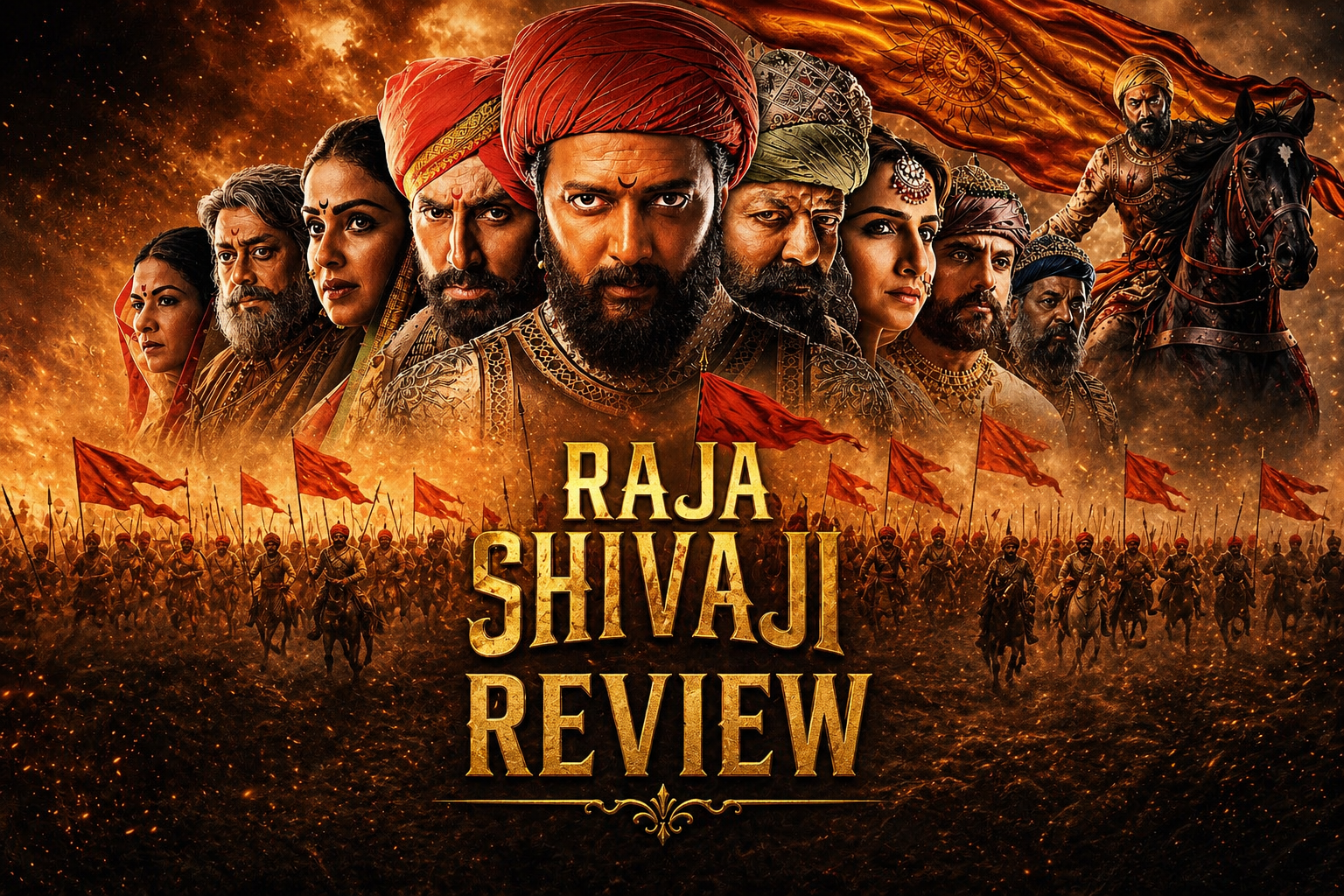
Raja Shivaji is a Marathi and Hindi historical epic releasing in theatres on May 1, 2026, directed by and starring Riteish Deshmukh in the role of Chhatrapati Shivaji Maharaj. Over a decade in the making, it is the most expensive Marathi film ever produced at a budget of Rs. 100 crore. The film delivers on nearly every dimension: Riteish Deshmukh’s performance is the finest of his career, Santosh Sivan’s cinematography is breathtaking throughout, Ajay-Atul’s music is powerfully suited to the material, and the battle sequences set a new benchmark for authentic large-scale action in Marathi cinema. A must-watch.
Watch the official Hindi trailer here: Raja Shivaji Hindi Trailer – YouTube Watch the official Marathi trailer here: Raja Shivaji Marathi Trailer – YouTube
| Detail | Info |
|---|---|
| Movie Name | Raja Shivaji |
| Language | Marathi and Hindi (dubbed in Telugu) |
| Theatrical Release | May 1, 2026 (Maharashtra Day) |
| OTT Release | Not announced yet |
| Platform | Theatre |
| Cast | Riteish Deshmukh, Genelia Deshmukh, Sanjay Dutt, Abhishek Bachchan, Mahesh Manjrekar, Sachin Khedekar, Bhagyashree, Fardeen Khan, Jitendra Joshi, Amole Gupte, Vidya Balan, Salman Khan (cameo as Jeeva Mahala) |
| Director | Riteish Deshmukh |
| Writers | Riteish Deshmukh, Prajakt Deshmukh, Jaideep Yadav |
| Music | Ajay-Atul |
| Cinematography | Santosh Sivan |
| Production | Mumbai Film Company |
| Producers | Genelia Deshmukh, Jyoti Deshpande |
| Presenter | Jio Studios |
| Runtime | 195 minutes (Marathi), 187 minutes (Hindi) |
| Certification | UA16+ |
| Budget | Rs. 100 crore |
| Advance Booking | Rs. 5.14 crore gross (Marathi version alone) |
| Our Rating | 8 / 10 |
Is Raja Shivaji Worth Watching?
Absolutely, and in the largest screen you can find. Raja Shivaji is not just the best Marathi film of the year, it is one of the most ambitious and genuinely rewarding historical epics Indian cinema has produced in recent memory. Riteish Deshmukh’s performance is transformative, the battle sequences are unlike anything Marathi cinema has staged before, and Ajay-Atul’s score gives the film an emotional spine that holds across three and a quarter hours. Some portions in the second half slow the pace slightly, but the film’s ambition and execution are on a level that demands to be seen on a big screen.
What Is Raja Shivaji About?
The film opens in the sixteenth century with the birth of Shivaji Bhosale and the geo-political landscape of the Deccan at that time. Multiple powers are competing for territory and influence, and the Bhosale family sits within a shifting, dangerous world where alliances last only as long as they are useful.
The film traces Shivaji’s journey from a young man shaped by his mother Jijabai’s fierce belief in the idea of Hindavi Swarajya, a kingdom governed by its own people for its own people, through the battles, betrayals, alliances, and moments of individual courage that brought the Maratha Empire into existence. The narrative does not try to cover every chapter of Shivaji’s history. It concentrates on the internal formation of his identity as a leader and the specific confrontations that tested and proved that identity.
The screenplay, co-written by Riteish Deshmukh, Prajakt Deshmukh, and Jaideep Yadav, works across multiple years of Shivaji’s life without losing the emotional thread. The approach is less a march through historical events and more a study of how a specific kind of moral and strategic courage develops under extreme pressure.
What Works
Riteish Deshmukh’s performance as Shivaji Maharaj. This is the performance that defines his entire career. He has spent years researching and inhabiting this character, and every moment of that preparation is visible on screen. What is remarkable is that he does not play Shivaji as a symbol or as an idea. He plays him as a human being with fears, doubts, and a very specific set of convictions. The leadership reads as earned rather than assumed, which is precisely what a historical biopic of this subject demands.
The battle sequences. Critics and audiences are unanimous that these set a new standard for authentic large-scale war action in Marathi cinema. The sequences are not choreographed to look impressive. They are staged to feel real, chaotic, and consequential. The scale is genuine rather than CGI-assisted spectacle, and that grounded quality makes them land harder than anything comparable in recent Indian cinema.
Santosh Sivan’s cinematography. He is one of the finest cinematographers Indian cinema has ever produced, and Raja Shivaji gives him material worthy of his abilities. The landscapes of the Western Ghats, shot across locations including Satara, Wai, and Mahabaleshwar, are photographed with the same care that was applied to the original historical texts that inspired the screenplay.
Ajay-Atul’s music. Their score gives the film its emotional grammar. The songs do not interrupt the narrative the way songs sometimes do in Indian epics. They deepen it. The battle sequences in particular use the music as a structural element rather than a garnish.
The ensemble cast. Sanjay Dutt and Abhishek Bachchan as antagonists deliver sustained threat without tipping into theatrical villainy. Genelia Deshmukh in the role of Maharani Saibai brings emotional depth to a character who exists largely in the spaces between the political action. Sachin Khedekar, Mahesh Manjrekar, and Bhagyashree all bring the kind of gravity the material demands.
Salman Khan’s cameo as Jeeva Mahala. Jeeva Mahala is the historical warrior known for protecting Shivaji Maharaj during the attack by Sayyad Banda. Salman Khan’s appearance in this role is the most talked-about moment in the film’s early audience reception, with theatres reportedly responding with thunderous applause. It is a brief appearance but it is staged and performed with enough intensity to be genuinely memorable.
Maharashtra Day release timing. Releasing a film about the founder of the Maratha Empire on May 1, Maharashtra Day, is a decision that connects the film to its audience in a way that goes beyond typical promotional strategy. The emotional charge that brings to a theatre full of Maharashtrian viewers is something the film earns through its sincerity rather than just its scheduling.
Record advance booking for Marathi cinema. The film’s Marathi version alone sold Rs. 3.60 crore net in advances, surpassing the opening-day figures of Sairat and Timepass 2. That is a cultural moment for the Marathi film industry, not just a trade number.
What Does Not Work
Some stretches in the second half slow the pacing noticeably. At over three hours, the film does not feel long during the action sequences or the emotionally driven personal scenes. But there are portions in the middle of the second half where the narrative momentum drops, and the film takes longer than it needs to move from one major sequence to the next.
The Hindi version cuts eight minutes from the Marathi cut. For Telugu and Hindi audiences approaching this as a dubbed experience, they are seeing a slightly compressed version of the story. The cuts have been described as sensible, but it is worth knowing that the complete cinematic experience is the Marathi version.
A PIL filed against the title before release. An NGO filed a Public Interest Litigation in the courts arguing that omitting the honorific “Chhatrapati” from the title was disrespectful to Shivaji Maharaj. The plea did not succeed, but it is part of the film’s pre-release context. Whether the title choice feels appropriate is something individual viewers will form their own view on.
Performances
Riteish Deshmukh (Wikipedia) has spent more than a decade bringing this film to existence as writer, director, and lead actor. The result is a performance that carries the full weight of that commitment. He is on screen for most of the three-hour runtime and gives the character enough internal variation, ranging from the young warrior finding his footing to the established leader making decisions that cost lives, that the length never feels like a single sustained note.
Genelia Deshmukh (Wikipedia) as Maharani Saibai brings a warmth and stillness to the role that prevents it from being purely decorative. In a film dominated by external conflict, her scenes with Riteish provide the film’s emotional resting place.
Sanjay Dutt (Wikipedia) and Abhishek Bachchan (Wikipedia) as the principal antagonists create consistent dramatic tension. Both avoid the trap of overplaying threat, and Sanjay Dutt in particular brings a cold pragmatism to his role that makes him feel genuinely dangerous without any theatrical gesturing.
Salman Khan (Wikipedia) as Jeeva Mahala gets very little screen time but uses it completely. The cameo is not a star appearance inserted for commercial value. It is a performance that fits the film’s register and adds to it.
Sachin Khedekar, Mahesh Manjrekar, and Bhagyashree are all precisely cast and reliable in roles that require historical credibility over star power.
Direction, Writing and Technical Elements
Riteish Deshmukh has spent most of his public career as a comedic actor in mainstream Hindi and Marathi films. Raja Shivaji reveals that he has been studying the craft of filmmaking for years at a level that was not previously visible in his earlier directorial work. His command of scale, his understanding of how to pace a historical narrative across three-plus hours, and his instinct for when to use the camera as a storytelling tool rather than just an observer, are all operating at a level that must have surprised many critics who came in with lowered expectations.
The screenplay, co-written with Prajakt Deshmukh and Jaideep Yadav, benefits from Riteish’s years of deep research into historical texts about Shivaji Maharaj. The dialogue has been specifically noted for its quality across both the Marathi and Hindi versions, with sources noting that even Hindi actors were given Hindi dialogue in the Marathi version rather than dubbed lines, which is an unusual and effective choice.
Santosh Sivan’s cinematography is the technical jewel of the production. It is worth specifically noting that filming took place across genuinely historical landscapes, including Satara, Wai, and the Western Ghats, rather than relying on recreated studio sets for everything. That authenticity translates directly to the screen.
Ajay-Atul’s music has been one of the most discussed elements of the film’s pre-release promotion and the in-theatre experience justifies the enthusiasm. The score during battle sequences is particularly strong.
Frequently Asked Questions
Is Raja Shivaji worth watching in theatres? Yes, absolutely. This is a film that was made specifically for the big screen and the experience will be significantly diminished on a small one. Prioritise a good audio setup if possible.
Who directed Raja Shivaji? Riteish Deshmukh wrote, directed, produced, and starred in the film. It is his passion project, in development in various forms since 2015.
What is Raja Shivaji about? The film chronicles the rise of Chhatrapati Shivaji Maharaj, founder of the Maratha Empire, from his early years through the battles and decisions that established Hindavi Swarajya.
Who plays Chhatrapati Shivaji Maharaj in Raja Shivaji? Riteish Deshmukh plays the title role. Audiences and critics have called it the finest performance of his career.
What is Salman Khan’s role in Raja Shivaji? Salman Khan plays Jeeva Mahala, a loyal warrior of Shivaji Maharaj who is historically known for protecting the Maratha king during the attack by Sayyad Banda. His appearance is a cameo but reportedly generates the loudest audience reaction in the film.
How long is Raja Shivaji? The Marathi version runs for 195 minutes. The Hindi version runs 187 minutes. The Telugu dubbed version’s runtime has not been separately confirmed.
What is Raja Shivaji’s budget? Rs. 100 crore, making it the most expensive Marathi film ever made.
When will Raja Shivaji release on OTT? No OTT platform or release date has been announced as of May 1, 2026.
In which languages is Raja Shivaji available? The film was produced simultaneously in Marathi and Hindi, with a Telugu dubbed version also releasing in theatres.
Final Verdict
CinemaCelebs Rating: 8 / 10
Raja Shivaji is a landmark film. Not just for Marathi cinema, which it elevates to a new commercial and artistic benchmark, but for Indian historical cinema generally. Riteish Deshmukh’s direction is far more assured than anyone who knew only his earlier work could have anticipated, his performance is the defining one of his career, and the technical team surrounding him, Santosh Sivan behind the camera and Ajay-Atul on the score, elevates the material to genuine spectacle. Some pacing issues in the second half and the compressed Hindi cut are real limitations, but they are minor relative to the scale of what the film achieves. This is a film that will be talked about in conversations about Indian historical cinema for years.
Watch it if: You have any interest in Marathi cinema, in Shivaji Maharaj’s history, in large-scale Indian historical filmmaking, or in watching a performer deliver the performance of a lifetime.
Skip it if: Three-plus hours of historical epic with limited comedy or romance is genuinely not for you. There is no action shortcut or lighter version of this film.