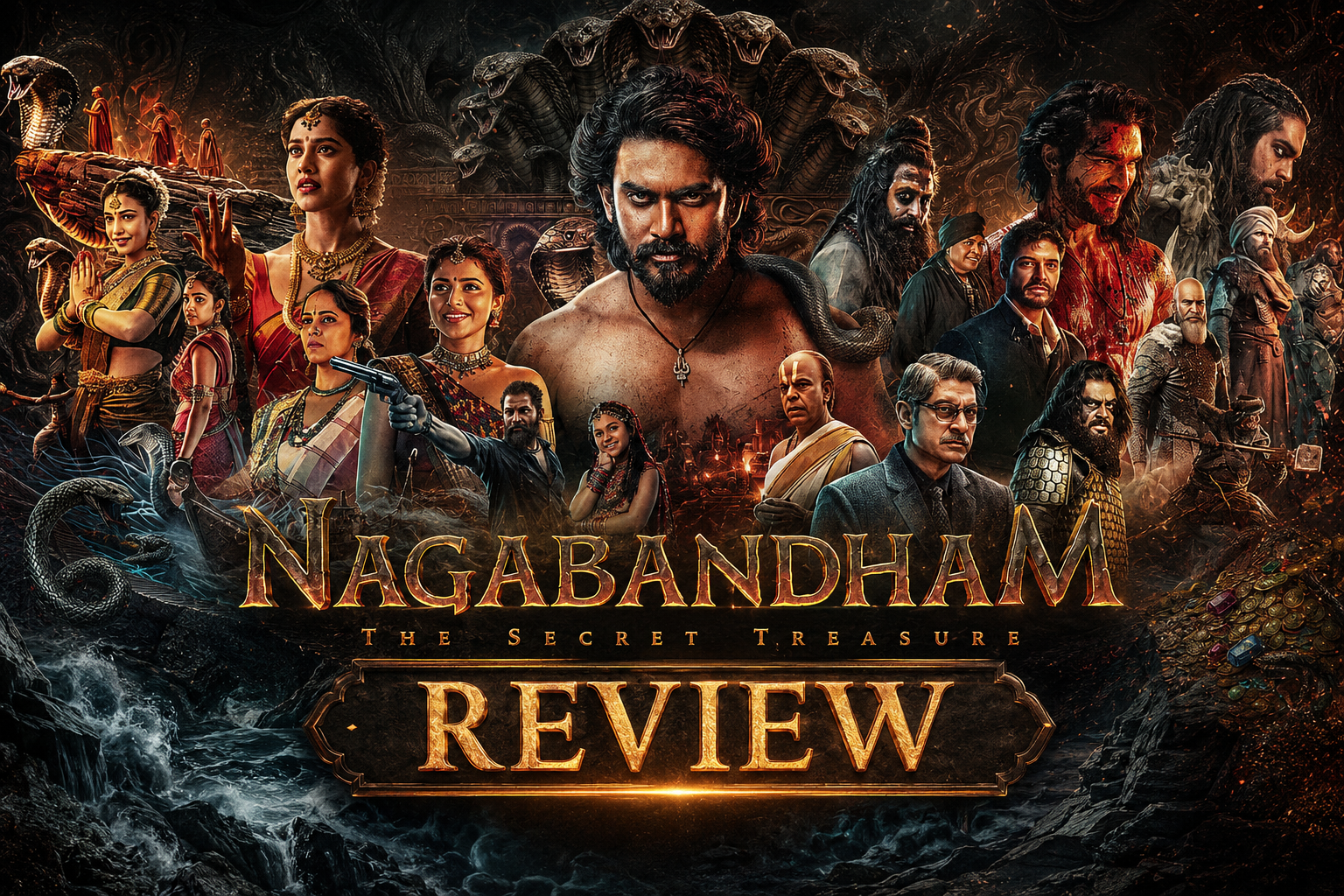
Nagabandham – The Secret Treasure is a Telugu-Hindi-Tamil mythological adventure that trades a tight script for temple-scale spectacle, and it shows within the first thirty minutes. If you walk in for visuals and devotional elevation, you’ll get plenty. If you walk in for a story that actually resolves, you’re going to leave with questions the makers are saving for a sequel.
| Detail | Info |
|---|---|
| Movie Name | Nagabandham – The Secret Treasure |
| Language | Telugu (also releasing in Hindi, Tamil) |
| Theatrical Release | July 3, 2026 |
| OTT Release | Not yet announced |
| Platform | In theatres worldwide |
| Audio Languages | Telugu, Hindi, Tamil |
| Cast | Virat Karrna, Nabha Natesh, Iswarya Menon, Jagapathi Babu, Mahesh Manjrekar, Murli Sharma, Rishabh Sawhney, Daksha Nagarkar, Anasuya Bharadwaj |
| Director | Abhishek Nama |
| Music | Junaid Kumar, Abhishikth Kothapalli |
| Cinematography | Soundar Rajan S |
| Production Design | Ashok Kumar |
| Production | NIK Studios, Abhishek Pictures, presented by Zee Studios |
| Runtime | 196 minutes (3 hours 16 minutes) |
| Certification | UA16+ |
| Trailer | Watch the official trailer |
| Our Rating | 5.5 / 10 |
Is Nagabandham Worth Watching?
Only if grand production design and temple-set spectacle are reason enough for you to sit through three hours and sixteen minutes. If you need a script that pays off its own central mystery by the time the lights come up, this isn’t that film, since the makers hold back the full Nagabandham secret for a planned second part.
What Is Nagabandham About?
The story opens in the Himalayas in 1962, where the hunt begins for a secret text called Nagabandham and the Brahmakamalam, a flower said to hold power over death itself. The Brahmakamalam now rests inside the Srirangapuram Ranganathaswamy Temple, and the film’s antagonist, Abdali (Rishabh Sawhney), wants both the book and the flower to unlock the doors that guard a hidden treasure and, with it, control over life and death. You can get a fuller sense of the tone from the official trailer.
Standing in his way is Rudra (Virat Karrna), a young man living an ordinary family life until a chain of events pulls him into the middle of Abdali’s search. The first half spends most of its time on Rudra’s family setup and the early stages of the Brahmakamalam hunt, building mystery in patches but slowing down repeatedly for track after track that has nothing to do with the actual plot.
The second half jumps back to a parallel story set in 1756, and this is where the film finally finds some urgency. The past and present threads start colliding, twists arrive at a better pace, and the devotional elevation sequences in the climax carry real scale. What they don’t carry is closure. The Nagabandham mystery the title is built around gets pushed to a follow-up film instead of resolved here.
What Works
The temple recreations. Production designer Ashok Kumar’s rebuild of the Anantha Padmanabha Swamy Temple and the Srirangapuram sets is the film’s most consistent asset. These aren’t backdrop dressing; whole sequences are staged to let the architecture do the emotional work, and it does.
The interval block and second-half mystery. Once the 1756 timeline kicks in, the screenplay stops repeating itself. The interval twist and the historical episodes that follow give the film a second wind it badly needed after a first half that drifts.
Background score over songs. Junaid Kumar and Abhishikth Kothapalli’s score does the heavy lifting in the devotional and action portions, landing harder than the soundtrack’s actual songs, which are forgettable and mostly present as first-half padding.
Virat Karrna and Rishabh Sawhney. Karrna is a newer face carrying a genuinely massive production on his shoulders, and he’s decent in both the action beats and the quieter emotional stretches. Sawhney, playing the antagonist Abdali, has the screen presence to make a villain worth watching, even when the writing around him leans on repeated massacre sequences instead of characterisation.
What Does Not Work
The runtime is the film’s biggest enemy. At 196 minutes, Nagabandham asks for more patience than its screenplay earns. The antagonist’s massacre sequences in particular go on far longer than the plot requires, turning scenes that should build dread into scenes that just build fatigue.
Withholding the title’s own mystery. Building an entire film around a ritual called Nagabandham and then declining to fully explain it, in order to save the reveal for a sequel, works against the audience rather than for them. It reads less like a cliffhanger and more like an unfinished script split into two releases.
Family and romantic tracks that stall the first half. Rudra’s home life gets extended screen time that doesn’t deepen his character enough to justify the detour, and the romantic track attached to it feels bolted on rather than built in.
Emotional beats that don’t land. For a film leaning this hard on Sanatana Dharma themes and devotional stakes, the emotional connect between Rudra and the people around him needed to be stronger. The visuals ask you to feel something the script hasn’t actually earned yet.
Performances
Virat Karrna plays Rudra with a straightforward sincerity that works better in the action portions than in the family scenes, where the writing gives him little beyond reaction shots. He’s a newcomer being handed a pan-India-scale film, and he holds his own without yet showing the range the role’s second half demands.
Nabha Natesh gets a part with two distinct shades, moving between a traditional register and a more glamorous one, and she handles both convincingly. It’s a better-written part for her than most heroine roles in films this size usually offer.
Rishabh Sawhney, as the antagonist Abdali, is one of the film’s clearer strengths. His screen presence carries scenes that would otherwise be running on visual scale alone.
Jagapathi Babu, Mahesh Manjrekar, Iswarya Menon, Murli Sharma, Anasuya Bharadwaj and Daksha Nagarkar round out a large supporting cast, each doing competent work within roles that are mostly functional rather than memorable. Jagapathi Babu, introduced as an archaeology expert piecing together the Nagabandham puzzle, gets the most to actually do among them.
Direction, Writing and Technical Elements
Abhishek Nama’s direction is unmistakably scale-first. Every choice, from the temple reconstructions to the way the 1756 flashback is staged, points toward visual grandeur as the film’s organizing principle, and on that specific axis, he delivers. What the direction doesn’t solve is pacing: the first half needed a tighter hand, and the massacre sequences needed a producer willing to cut them down.
The writing is where the film runs into real trouble. Treasure-hunt narratives built around a Sanatana Dharma framework aren’t new territory for Telugu cinema right now, and Nagabandham doesn’t bring a fresh angle to the structure beyond its production values. Splitting the central mystery across two films is a franchise decision, not a storytelling one, and it leaves this installment feeling incomplete on its own terms.
Technically, Soundar Rajan S’s cinematography is the film’s standout department, giving the temple and mountain sequences a scale that matches the budget on screen. The editing, however, needed to be considerably tighter, particularly in trimming the repeated antagonist massacre sequences that stretch the first half well past where the story’s actual content justifies.
How Does Nagabandham Compare?
Nagabandham sits closer to Adipurush and Kalki 2898 AD in ambition than to a traditional Telugu mythological drama, chasing pan-India scale and VFX-heavy set pieces over a self-contained story. Like both of those films, it leans on grandeur to carry a screenplay that isn’t fully cooked, and like both, the gap between what’s on screen and what’s actually written becomes the thing critics and audiences argue about most.
Where to Watch Nagabandham
Nagabandham – The Secret Treasure is currently a theatrical-only release, playing in Telugu, Hindi and Tamil across India and overseas from July 3, 2026. No OTT date has been announced yet, so for now the only way to watch it is on the big screen; catch the official trailer if you’re deciding whether it’s worth a theatre ticket.
Frequently Asked Questions
Is Nagabandham – The Secret Treasure worth watching in theatres?
It’s worth it mainly for viewers who go for large-scale visuals and temple set design over a tightly written plot. If you need the film’s own central mystery resolved by the end, temper your expectations.
What is Nagabandham – The Secret Treasure about?
It follows the hunt for the Brahmakamalam, a mystical flower with power over death, and the secret ritual text called Nagabandham that guards it, told across a 1962 present-day timeline and a 1756 historical one.
Is Nagabandham – The Secret Treasure available in Telugu?
Yes. It has released simultaneously in Telugu, Hindi and Tamil in theatres from July 3, 2026.
Who directed Nagabandham – The Secret Treasure?
Abhishek Nama directed the film, his most ambitious production to date, backed by NIK Studios and Abhishek Pictures.
What is the rating of Nagabandham – The Secret Treasure?
The film carries a UA16+ certification. CinemaCelebs rates it 5.5/10, reflecting strong visuals against a stretched, unresolved script.
Is Nagabandham – The Secret Treasure based on a true story?
No. It’s a fictional mythological adventure built around the Anantha Padmanabha Swamy Temple lore and an invented ritual called Nagabandham, not a documented historical event.
How long is Nagabandham – The Secret Treasure?
196 minutes, or 3 hours and 16 minutes. It does not earn that length; the first half in particular would have benefited from a tighter cut.
Is there a sequel planned for Nagabandham?
The film leaves its central mystery unresolved by design, strongly signalling a Part 2 to complete the Nagabandham storyline.
Final Verdict
CinemaCelebs Rating: 5.5 / 10
Nagabandham – The Secret Treasure is a film that spent its budget on the right things and its screenplay on the wrong ones. The temple sets, the cinematography and a genuinely engaging second half push it above the average mythological cash-in, but a bloated 196-minute runtime, repetitive antagonist violence, and a mystery deliberately left unsolved keep it from being the complete theatrical experience its scale promises.
Watch it if: you’re drawn to large-canvas mythological adventures and can forgive an unresolved plot in exchange for spectacle.
Skip it if: you need a self-contained story that wraps up by the time the credits roll.
In theatres now in Telugu, Hindi and Tamil, worldwide.