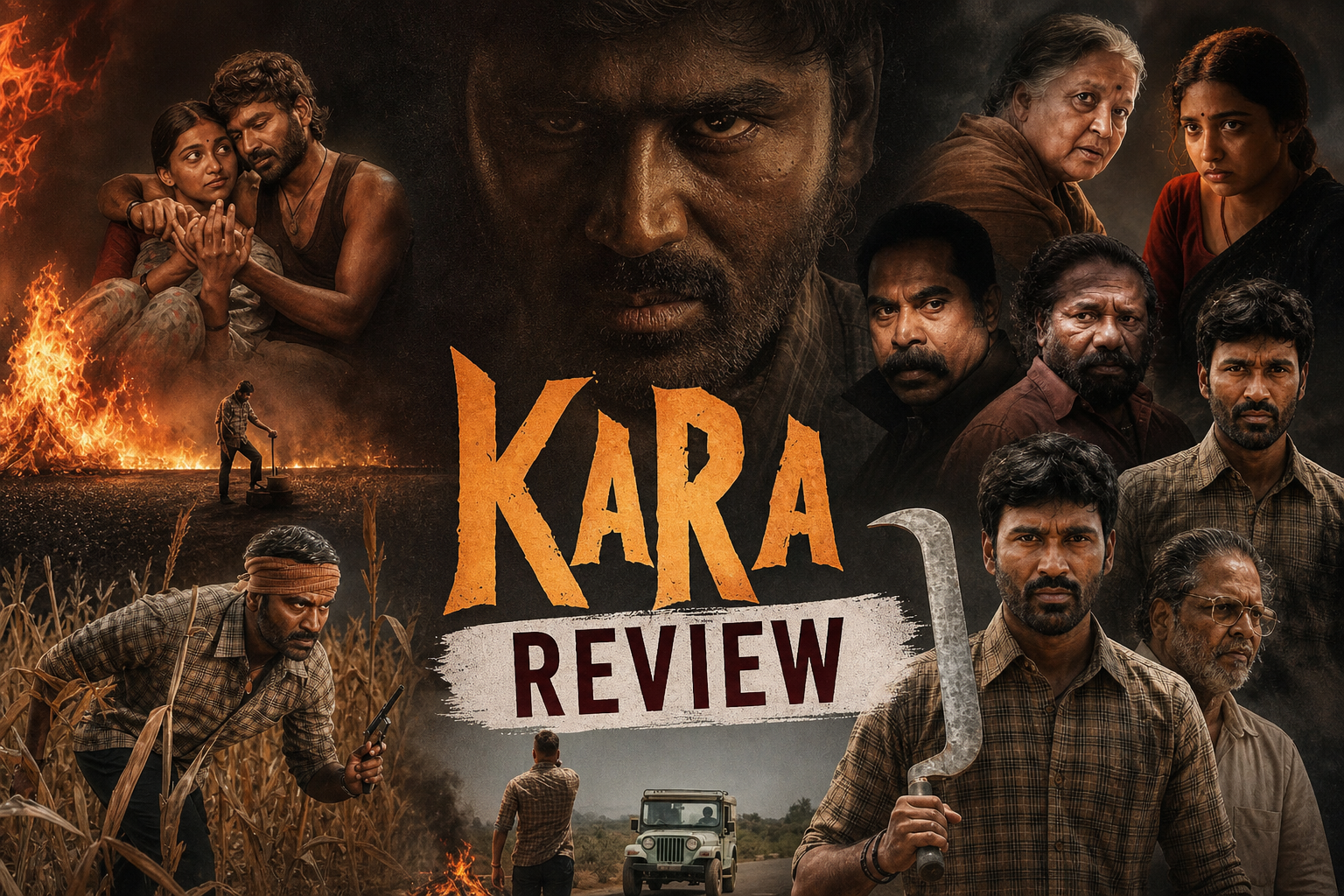
Kara is a Tamil rural heist thriller releasing in theatres on April 30, 2026, directed by Vignesh Raja and starring Dhanush in his 54th lead role. The first half is genuinely outstanding, building a morally layered story with extraordinary care and precision. The second half abandons most of that craft to chase a safer, more conventional ending. The result is a film that is well worth watching for Dhanush alone, while leaving you frustrated about what it could have been with more courageous writing at the finish line.
Watch the official trailer here: Kara Official Trailer – YouTube
| Detail | Info |
|---|---|
| Movie Name | Kara |
| Language | Tamil |
| Theatrical Release | April 30, 2026 |
| OTT Release | Not announced yet |
| Platform | Theatre |
| Cast | Dhanush, Mamitha Baiju, K.S. Ravikumar, Karunas, Jayaram, Prithvi Pandiarajan, Suraj Venjaramoodu, M.S. Bhaskar, Sreeja Ravi |
| Director | Vignesh Raja (Por Thozhil) |
| Music | GV Prakash Kumar |
| Cinematography | Theni Eswar |
| Editing | Sreejith Sarang |
| Producers | Dr. Ishari K. Ganesh |
| Production | Vels Film International and Think Studios |
| Setting | Ramanathapuram, Tamil Nadu, 1991 |
| Runtime | Approximately 2 hours 30 minutes |
| Certification | U/A |
| Day 1 Box Office | Rs. 6.6 crore |
| Our Rating | 6.5 / 10 |
Is Kara Worth Watching?
Yes, but go in knowing that the first half and the second half feel like two different films. Dhanush’s performance alone is worth the ticket price. The heist sequences are some of the most meticulously staged in recent Tamil cinema. But the film softens its moral complexity exactly when it should be sharpening it, and the final act replaces nuance with crowd-pleasing sentiment. Worth watching in theatres if you can accept that frustration as part of the deal.
What Is Kara About?
Karasaami, known as Kara, is a thief by background and by instinct. After a stint in jail and a period working at a small hotel in Renigunta, Andhra Pradesh with his wife Selli, he returns home to Ramanathapuram in desperate need of money. What he finds is that his father Kandhasaamy has been crushed under a bank loan he could never realistically repay. The land the family farmed for generations is now effectively owned by the bank, held through exploitative interest rates and charges that no rural family could absorb.
The film is set in 1991, against the backdrop of the Gulf War and the fuel price crisis that rippled through India at the time. These events are not the focus of the story, but they create the economic walls that Kara cannot get through by honest means. With no legal path forward, Kara begins planning a robbery that is less about personal greed and more about settling a debt that was never fair to begin with.
What makes the setup compelling is that Vignesh Raja is careful from the very first sequence to position Kara not as a hero but as a desperate man who has made peace with his own moral compromises. The tension of the first half comes from watching that compromise become increasingly costly, and from the relentless pursuit of an exceptionally determined police officer who is as committed to his job as Kara is to his.
What Works
Dhanush’s performance throughout. The desperation and quiet anger of Karasaami are written into Dhanush’s face in almost every frame. He does not play the character as a romantic outlaw or a crowd-pleasing rebel. He plays him as someone who is running out of road and knows it. The scenes where Kara is treating each theft as a kind of devotional act, almost like a ritual he has surrendered himself to, give Dhanush material that is genuinely unusual for mainstream Tamil cinema.
The interval sequence. Vignesh Raja stages the best sequence in the film here. The police are closing in, the stakes are at their highest, and a reaction shot of Dhanush’s face framed through the holster of a police officer’s pistol is the kind of visual choice that stays with you. The tension in the buildup is almost unbearable in the best possible way.
Suraj Venjaramoodu as the police officer. He plays a cop who is not corrupt, not comical, and not sympathetic to the thief’s circumstances. He simply believes in the law and is very good at his job. That straightforwardness makes him far more threatening as an antagonist than a traditional villain would be, and Suraj brings a quiet, menacing persistence to every scene.
Theni Eswar’s cinematography. The visual language throughout the first half is pointed and specific. Kara is almost always shot with a shadow falling across him even in daylight, constantly reinforcing his moral position. When lightning is used to reveal scale, it is used purposefully. When the rain hits in the opening, it is doing emotional work. This is cinematography as storytelling, not just as atmosphere.
The 1991 period setting and production design. Ramanathapuram as it looked in the early nineties has been recreated with real attention to texture. The absence of mobile phones and CCTV cameras is written into the story rather than treated as a limitation, and the film is smarter for it. The scene involving a tractor, specifically what it represents about who holds economic power in a rural setting, is a detail that rewards paying attention.
GV Prakash Kumar’s background score. The songs work better inside the film than they did as standalone tracks, and the background score is exceptional. It elevates tense sequences without overplaying them and stays rooted in the period without feeling like a costume.
What Does Not Work
The second half loses the moral complexity the first half built. The film shifts Kara from a grey, compromised character into something closer to a Robin Hood figure, and the shift is handled with considerably less subtlety than everything that came before. The writing begins underlining its own themes rather than trusting the audience to feel them.
Jayaram’s character is reduced to a flat antagonist. For most of the first half, the bank manager he plays functions as a complex third corner in a triangle with Kara and the police. In the second half, his motivations narrow and he becomes a standard-issue villain. A film that spent so much care on grey characters deserved a more daring choice here.
The sentiment in the pre-interval sections does not land as cleanly as intended. The father-son dynamic between Dhanush and K.S. Ravikumar is genuinely moving in its best moments, but some of the melodramatic beats between them lean on familiar Tamil cinema shortcuts that feel out of place in a film this grounded everywhere else.
The final act rushes where the film should slow down. After the heist sequences build to a convincing peak, the wrap-up arrives quickly and tidy-mindedly. The film wants closure, which is understandable. The problem is that the closure it chooses erases the ambiguity that made the first hour and a half genuinely special.
Performances
Dhanush (Wikipedia) has rarely been used this well in terms of sheer screen presence. This is not a role that asks him to be charming or funny or romantic. It asks him to carry sustained moral weight across a two-and-a-half-hour film, and he does it without a moment of overperformance. His Kara feels like a real person with a specific history rather than a movie character designed around a star image.
Mamitha Baiju (Wikipedia) plays Selli, the wife who knows exactly who her husband is and chooses to stand by him regardless. The role is not written with great depth but she handles it with sincerity. The colourism controversy around her casting, specifically the decision to darken her skin to make her appear Tamil rather than casting a native Tamil actress, is a legitimate criticism that the film cannot fully address on screen.
K.S. Ravikumar as the father Kandhasaamy gives the film its emotional foundation in the first half. His portrayal of a man slowly crushed by a debt he did not fully understand is quiet and specific. He does not ask for the audience’s sympathy loudly, which makes it more effective when the sympathy arrives.
Suraj Venjaramoodu (Wikipedia) is the film’s most underrated performance. In a film where the protagonist is written to be relatable, playing the pursuing officer as fully committed to doing his job, without making him a caricature, is harder than it looks.
Jayaram (Wikipedia) does strong work in the first half and is let down by the writing in the second. Karunas, reuniting with Dhanush after sixteen years, brings warmth to a supporting role. M.S. Bhaskar appears in a scene designed to underline the film’s justice angle, and while he delivers, the scene itself is too on-the-nose for a film that handled its themes more elegantly elsewhere.
Direction, Writing and Technical Elements
Vignesh Raja made Por Thozhil in 2023, a film about police procedure and moral accountability that built extraordinary tension through character logic and cinematic restraint. Kara shares its best qualities with that film. The instinct to frame moral complexity through visual storytelling rather than dialogue, the patience in letting tension accumulate before releasing it, the refusal to make the protagonist straightforwardly heroic. These qualities drive the first half and make it one of the better stretches of Tamil cinema this year.
The writing, co-developed with Alfred Prakash, is where the film reveals its limitations. The screenplay builds a beautifully designed first half and then, in trying to deliver a version of the story that feels satisfying to the widest possible audience, trades specificity for sentiment. The film is set up to be uncomfortable in a productive way, and it chooses comfort instead.
Theni Eswar’s cinematography is consistent throughout and genuinely brilliant in key sequences. GV Prakash Kumar’s score is one of his better recent efforts. Sreejith Sarang’s editing is precise in the heist sequences and looser in the emotional passages, mirroring the film’s own tonal unevenness in a way that feels accurate to the material rather than like a separate problem.
Frequently Asked Questions
Is Kara worth watching in theatres? Yes. The first half alone is worth the ticket, and Dhanush’s performance throughout is among the best of his recent career. Go in knowing the second half is a step down.
Who directed Kara? Vignesh Raja, who previously directed the critically acclaimed Tamil thriller Por Thozhil (2023), directed Kara.
What is Kara about? A thief in rural Tamil Nadu, set in 1991, returns home to find his father drowning in an exploitative bank loan and plans a robbery to set things right.
What does Kara mean in Tamil? Kara is derived from the protagonist’s full name Karasaami, which the character shortens himself. The word also carries connotations of sharpness and severity in Tamil.
Is Kara available in Telugu and Hindi? Yes. The film released with Telugu and Hindi dubbed versions simultaneously.
When will Kara release on OTT? No OTT platform or date has been confirmed as of May 1, 2026.
What controversy surrounded Kara before release? An unrelated Tamil film titled Karaa, releasing on May 15, caused public confusion due to identical spelling. Karaa’s producer filed a legal challenge in the Madras High Court three days before Kara’s release attempting to stall it. The challenge did not succeed. Separately, the casting of Mamitha Baiju drew colourism criticism.
Final Verdict
CinemaCelebs Rating: 6.5 / 10
Kara is an impressive Tamil film that stops short of being a great one. Vignesh Raja’s instincts as a filmmaker are clearly at a high level, and the first hour and a half showcases writing and direction that Tamil cinema does not produce often enough. Dhanush’s performance is a reminder of what he is capable of when cast against his comfort zone. But the second half retreats from the moral complexity the film spends so long building, and the final act settles for an ending that is satisfying in the most conventional and least interesting way possible. A flawed but genuinely worthwhile theatre experience.
Watch it if: You appreciate grounded Tamil heist cinema, Dhanush at full intensity, or Vignesh Raja’s specific brand of slow-burn tension.
Skip it if: You need a second half that matches the promise of the first, or a clean moral conclusion to a complicated story.